August Moon Festival in Boston's Chinatown
I moved from Boston to Maine several years ago, and there is a particular quality of August morning up here, the light already carrying the first hint of something cooler underneath the summer warmth, the angle of it changed just enough from July to notice, that always sends me back to Chinatown. To Harrison Avenue on a Sunday. To the sound of lion dance drums beginning before you can see the source of them, the percussion coming through the ground before it comes through the air. To the smell of mooncakes and the particular dense press of a festival street crowd that is somehow both celebratory and intimate at once. I teach comparative religion and contemplative studies at a small college on the Maine coast, and every year when August comes around I find myself thinking about what the festival was actually saying, what it has been saying for three thousand years, and whether my students, most of whom have never been to Boston's Chinatown at all, have access to anything in their own lives that offers them the same teaching in the same concentrated form.
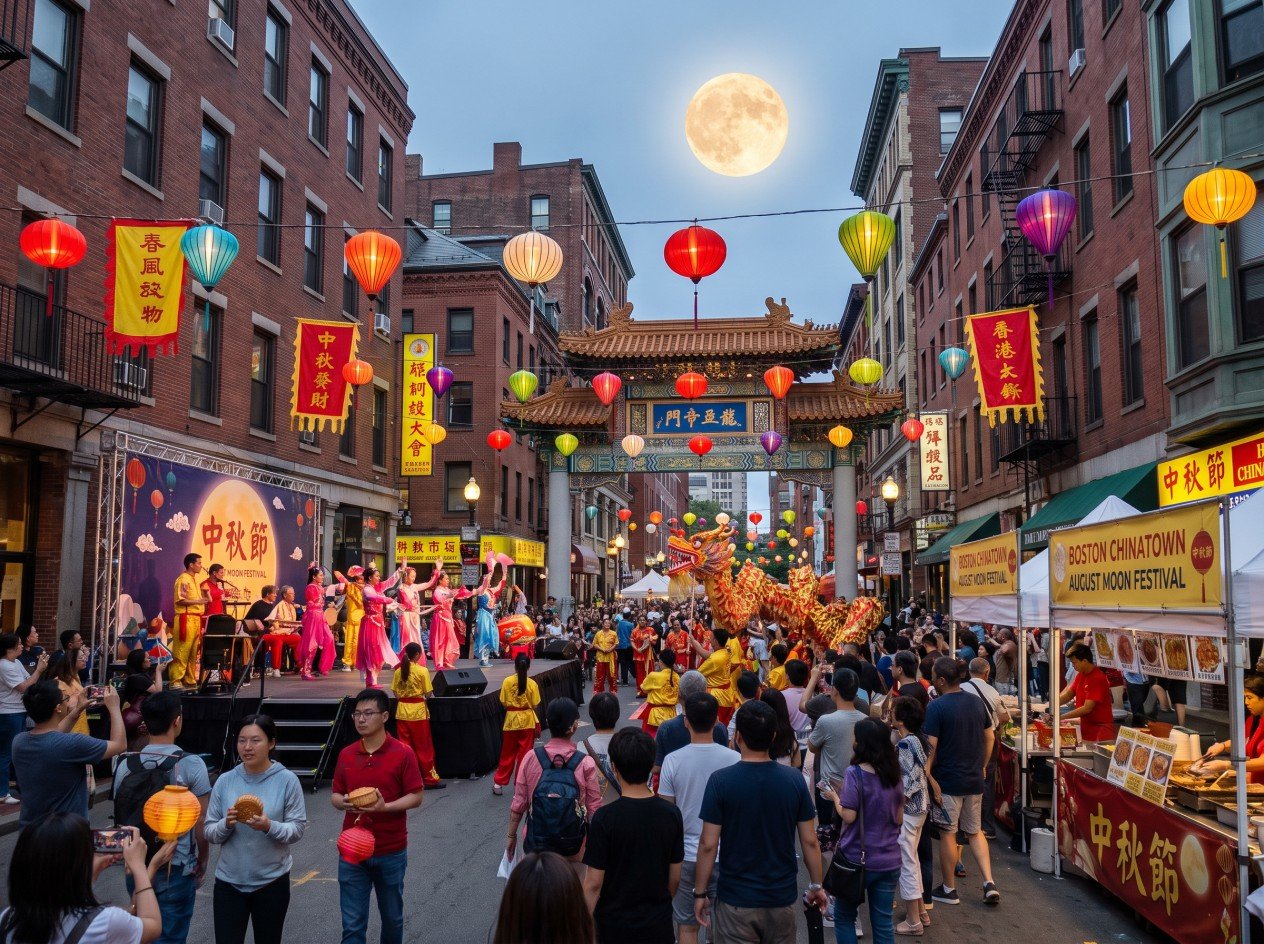
The 56th annual Chinatown August Moon Festival took place this year on August 9th, 2026 organised as always by the Chinese Consolidated Benevolent Association of New England, filling Harrison Avenue and Beach Street with lion dances, Chinese opera, folk dancing, food vendors, and the kind of communal energy that a city generates only when it is genuinely celebrating something rather than merely staging something for consumption. It is free, it is all ages, it is one of the two great public moments in Boston Chinatown's annual calendar, second in importance only to the Lunar New Year, and it has been happening in this neighbourhood, in some form, since 1970. The festival it commemorates is far older than that. The Mid-Autumn Festival has been observed in China for more than three thousand years, falling on the fifteenth day of the eighth lunar month, when the moon is at its fullest and most perfectly round. This year the traditional lunar date falls in late September. Boston, characteristically, celebrates it in August, which is partly pragmatic, the weather is better, the streets are more hospitable, and partly, I have come to think, its own kind of wisdom. August is when the turning begins. When the light starts its annual conversation with darkness. When the fullness of summer begins, imperceptibly, to give way.
Boston Chinatown August Moon Festival
The festival gathers several meanings under a single roof, or rather under a single open sky, and it is worth sitting with each of them because each offers something specific to anyone interested in the inner life. The most ancient meaning is the harvest, the giving of thanks for the abundance that the year has produced, the acknowledgment that what sustains us does not come from our own cleverness alone but from a cooperation between human effort and something larger that we did not create and cannot fully control. In a culture that increasingly understands productivity as a purely individual achievement, this is not a trivial reminder. The harvest festival says, you didn't do this alone. The moon did some of this. The rain did some of this. The soil and the season and the ten thousand decisions made by ten thousand people before you were born did some of this. Gratitude, in this understanding, isn't merely a pleasant emotion. It is an accurate perception of how things actually are.
The second meaning is the moon herself, and specifically the legend of Chang'e, the immortal Lady of the Moon who drank the elixir of immortality and floated upward to live in the lunar palace, separated forever from her husband Hou Yi, the divine archer who shot down nine of the ten suns to save the earth from burning. The legend has been interpreted many ways across three thousand years of telling. What strikes me most, from the perspective of contemplative studies, is the quality of Chang'e's condition. She is complete, she is luminous, she is elevated, and she is alone with her completeness in a way that is neither entirely tragedy nor entirely transcendence. The moon, after all, does not generate its own light. It receives the sun's light and gives it back transformed, at a cooler and more endurable intensity, to a world that is trying to see in the dark. This is a precise description of what the contemplative traditions call the witness, the awareness that receives what comes to it and reflects it back without adding or subtracting from the truth of it. Chang'e in her lunar palace is not celebrating. She is present. There is a difference that the festival, in its fullness and its noise and its community warmth, holds space for both of simultaneously.
Zhu Yuanzhang & The Mid-Autumn Festival
The third meaning, the one that I find most useful to bring to students who are sometimes suspicious of anything that sounds too transcendent, is the most political and the most earthy. During the Mongol occupation of China in the fourteenth century, the rebel leader Zhu Yuanzhang is said to have used the Mid-Autumn Festival as cover for the coordination of uprising, that involved messages hidden inside mooncakes, distributed across a nation under foreign rule, carrying the instruction to act on the same night under the same full moon. The festival, in this reading, is the teaching that a community that shares a symbol, a calendar, a way of looking up at the same sky together on the same night, is a community that cannot be entirely atomised. The full moon visible to everyone simultaneously is the most democratic of meeting places. You do not need to be in the same city to be, in some meaningful sense, together.
I think about this every August when I am not in Boston, when I am here in Maine, watching the same moon rise over a different landscape, knowing that Harrison Avenue is full and loud and fragrant with mooncakes and that I am, in the most important sense, still part of what is being celebrated. The festival teaches what seven years in Maine have only deepened i.e., that the spiritual life is not a private project. It is a community undertaking, calibrated to the rhythms of a natural world that does not consult our preferences before it proceeds with its turning. The moon rises when it rises. The harvest comes when it comes. The light changes in August whether we are ready for it or not.
If I were in Boston next August (2027), I would arrive early, before the main stage at Phillips Square fills. I would eat dim sum first, somewhere on Tyler Street, in the particular way that eating well before a ceremony is itself a form of preparation. And then I would stand in the crowd for the lion dance, for the drums and the colour and the disciplined joy of it, and I would let myself be reminded of the thing the festival has been saying for three thousand years and that is that abundance is real, that community is the container in which the inner life actually develops, that the moon does not generate its own light and neither do we, and that this is not a deficiency but the very structure of how things are made. We receive. We reflect. We give back, transformed, what came to us. The lion dances, and the street fills, and the moon rises on schedule, indifferent to whether we are watching and luminous regardless.