The Use of Tarot in Jungian Psychology
It is important to note that Jung never wrote systematically about tarot. This is worth acknowledging at the outset, because the relationship between Jungian psychology and tarot is sometimes presented as more direct and more authorised than it actually is/was. What Jung did do, extensively and with genuine intellectual rigour, was develop a framework for understanding the psyche, the concept of archetypes, the theory of the collective unconscious, the idea of individuation as the central project of psychological maturity, that maps onto the structure and imagery of the tarot with a coherence that is, depending on your epistemological commitments, either a remarkable coincidence or a confirmation that both systems are tracking the same underlying realities of human experience. I have spent enough time in both traditions to find the second possibility at least as interesting as the first.
The foundational concept here is the archetype. Jung proposed that beneath the personal unconscious, the layer of repressed memories, unprocessed experiences, and forgotten impressions that Freud had already mapped, there lies a deeper stratum he called the collective unconscious: a layer of psychic structure shared across all human beings, regardless of culture or historical period, containing inherited patterns of experience and response that he called archetypes. These are not images but image-generating structures, predispositions toward certain kinds of experience, certain patterns of relationship, certain fundamental human situations that produce recognisable symbolic forms across different times and places. The Great Mother. The Trickster. The Hero. The Wise Old Man. The Shadow. The Self.
Tarot & Archetypes
The Major Arcana of the tarot, the twenty-two trump cards that form the spine of the deck, are, in this reading, a pictorial catalogue of the most significant archetypes in the Western symbolic tradition. This is not a claim Jung made explicitly, but it is a claim that a number of thinkers working in the tradition he founded have found compelling, and it is a claim that holds up reasonably well under examination. The Fool is the archetype of the pure potential prior to any particular identity, the Self before it has been shaped by experience, setting out on the journey of individuation with nothing but openness. The High Priestess is a form of the Anima, the feminine principle within the male psyche, and more broadly the archetype of inner knowing, of the unconscious itself as a source of wisdom rather than merely a repository of repressed material. The Emperor is the Father archetype, authority and structure and the capacity to impose order on the chaos of experience. The Moon is the archetype of the unconscious in its most threatening and disorienting form, the flooding of rational consciousness by irrational, imaginal, frightening depths. The Sun is the archetype of consciousness itself, of clarity, of the ego's capacity to know and to illuminate.
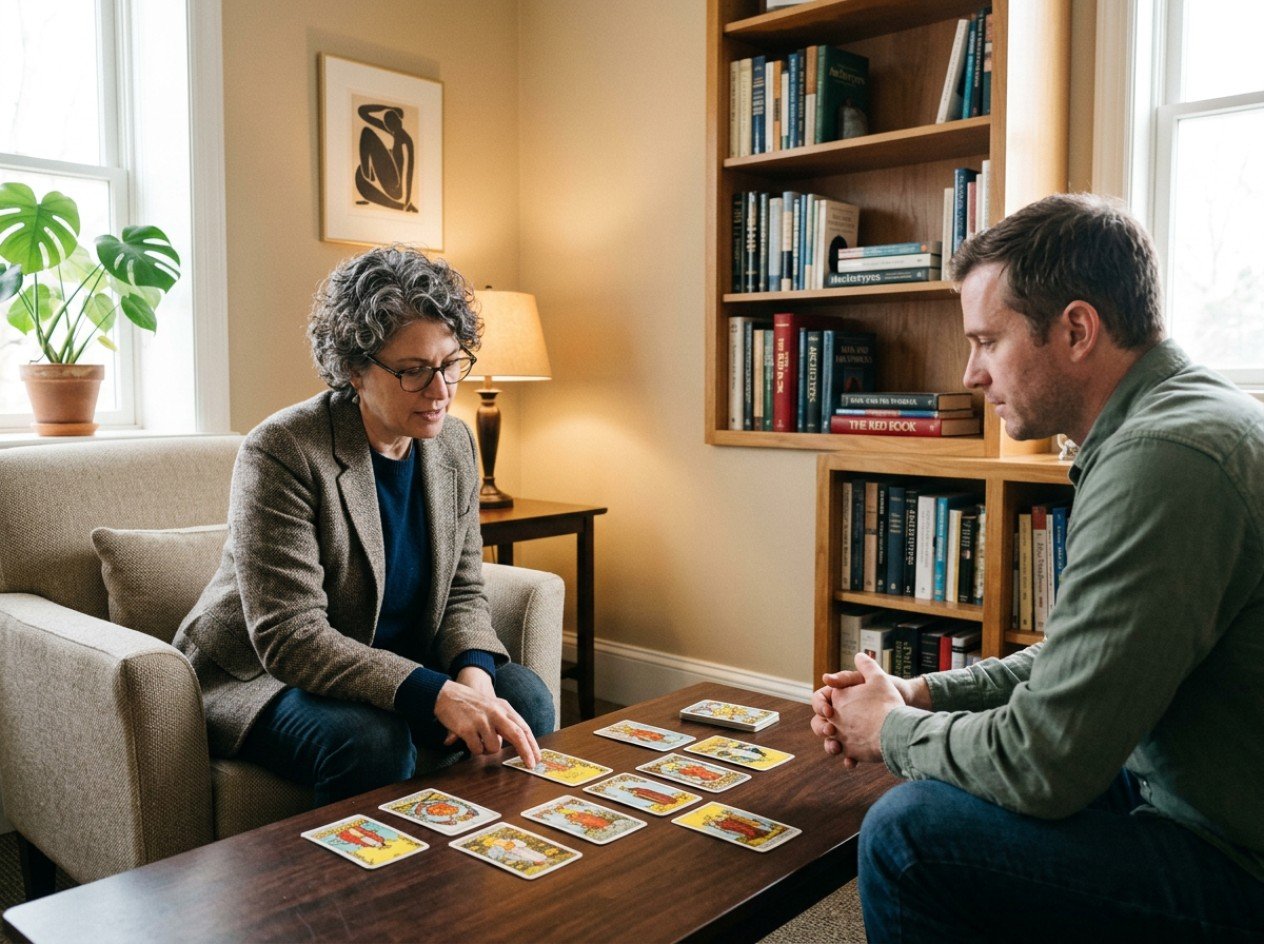
What makes this correspondence more than a superficial mapping exercise is the question of what tarot is actually for. The standard contemporary use of tarot as a divination system, drawing cards to receive guidance about the future, is, from a Jungian perspective, less interesting than the psychological process that actually occurs when someone sits with a card and attempts to understand what it is saying to them in the context of their particular life. What the card becomes, in that engagement, is what Jung called a symbol: not a sign pointing to a fixed, pre-determined meaning, but a living image that gathers around it more meaning than can be fully articulated, that draws the psyche toward something it does not yet consciously know. Jung distinguished carefully between signs, which are exhausted by their reference, and symbols, which are inexhaustible, which always point toward something just beyond the reach of rational formulation. The archetypes of the collective unconscious can only be approached through symbols. The tarot images, in the hands of someone genuinely engaged with them rather than merely consulting them for answers, function as precisely this kind of symbol.
This is why the practice of what some Jungian-influenced therapists and analysts call active imagination with tarot is considerably more psychologically interesting than fortune-telling. Active imagination was one of Jung's central techniques for engaging the unconscious: rather than simply interpreting the symbols that arise in dreams or fantasies, the practitioner enters into a kind of dialogue with them, allowing the images to move and speak and respond while maintaining enough ego-consciousness to participate rather than be overwhelmed. Working with a tarot card in this way, sitting with the image, entering it imaginatively, allowing it to become a space that the psyche can explore, produces a kind of insight that rational analysis alone does not generate. The card is not telling you what will happen. It is providing a symbolic container within which something that was unconscious can become conscious.
Sallie Nichols, Jung & Tarot
Sallie Nichols's 1980 book Jung and Tarot: An Archetypal Journey remains the most sustained and most serious attempt to work through this correspondence systematically. Nichols was a Jungian analyst who brought genuine scholarly care to the project, and while the book has its limitations, it is primarily focused on the Rider-Waite deck and takes a fairly linear view of the Major Arcana as a developmental sequence, it demonstrates convincingly that the Jungian framework is not simply being imposed on the cards from outside but is genuinely illuminated by them and genuinely illuminating of them. The two systems are in genuine dialogue.
There is also the question of the Shadow, which is perhaps Jung's most practically important concept and which the tarot addresses more directly than most psychological frameworks I know of. The Shadow is the repository of everything the conscious ego has rejected, not only the obviously unacceptable impulses, but also unlived potentials, undeveloped capacities, aspects of the self that were suppressed for social or familial reasons rather than moral ones. In a Jungian reading, cards that produce strong negative reactions in the person drawing them, the Tower, the Devil, the Ten of Swords, deserve particular attention precisely because of that reaction. The intensity of the aversion is often a reliable indicator of Shadow material: something the psyche is refusing to look at directly that is being reflected back through the card's imagery. The tarot's capacity to surface exactly this kind of uncomfortable recognition is, from a Jungian standpoint, not a liability but one of its most valuable features.
The concept of individuation, the lifelong process by which the psyche moves toward greater wholeness, integrating what has been dissociated and developing a relationship between the ego and the Self that Jung distinguished from all the partial identifications with archetypes along the way, maps with striking clarity onto the Fool's Journey, the narrative reading of the Major Arcana as a sequence of initiatory experiences through which the Fool passes from innocent beginning to integrated wholeness. I am cautious about pushing this correspondence too hard; the tarot is a complex historical artifact with roots in fifteenth-century Italian card games and a Renaissance humanist symbolic inheritance that predates Jung by four centuries, and I am wary of the kind of interpretation that collapses historical particularity into archetypal generality. But the coherence is genuine and worth taking seriously.
What I find most compelling about the Jungian approach to tarot is not the mapping of specific cards onto specific archetypes, which can become mechanical, but the broader epistemological claim it rests on the idea, that the psyche communicates with itself through images rather than propositions, that the symbolic dimension of experience is not a primitive precursor to rational thought but a distinct and irreplaceable mode of knowing, and that the ancient human practice of sitting with images and allowing them to speak is not superstition but something considerably more interesting. The tarot survived five centuries not because it reliably predicted the future, it doesn't, but because the images it contains are alive in the way that genuine symbols are alive. They keep generating meaning. They refuse to be exhausted. That is a Jungian fact, whether Jung said so or not.