


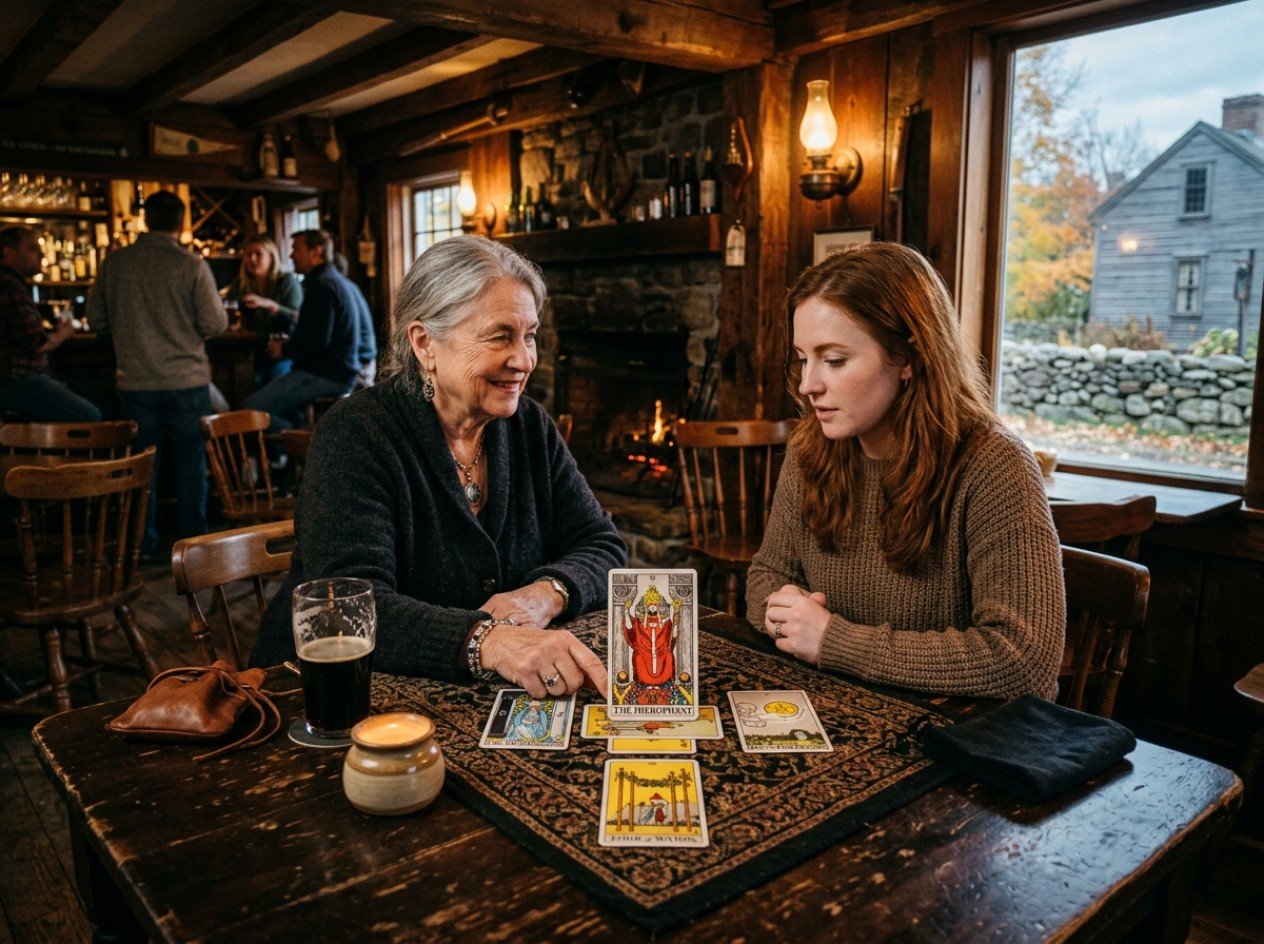
The Hierophant In Tarot Card Readings
I want to begin with the word itself, because the word is doing rather a lot of work that most people who encounter this card never stop to examine. Hierophant. It comes from the Greek hierophantēs, hieros, sacred, and phainein, to show or reveal. The hierophant was a specific figure in ancient Greek religious life: the high priest at the Eleusinian Mysteries, the great initiatory cult of Demeter and Persephone at Eleusis, outside Athens. His function was not to teach doctrine in any sense we would recognise from Western religious education. His function was to show the sacred, to make the invisible visible, to reveal the holy to the initiate at the culminating moment of a transformative ritual experience. He was, in the vocabulary of religious studies, a mystagogue: a guide into mystery.
<Misinterpretations of the Hierophant
This matters for understanding the tarot card, because the Hierophant is consistently misread, particularly in contemporary spiritual contexts, where he tends to get reduced to a symbol of institutional religion, dogma, and the kind of rigid authority that self-directed spiritual seekers are fairly explicitly trying to get away from. In the Rider-Waite-Smith deck, which is the version most people work with and which Arthur Edward Waite and Pamela Colman Smith published in 1909 drawing on a rich inheritance of Western esoteric tradition, the Hierophant sits between two pillars in ecclesiastical robes, his right hand raised in what appears to be a conventional Christian priestly blessing. Two monks or acolytes kneel before him. The iconography is deliberate and specific, and it is not, on its surface, welcoming to anyone who has complicated feelings about organised religion. I understand that response. What I want to argue is that it misses most of what the card is actually about.
Let me approach it from the anthropological angle, which is how I approach most things. Every human culture that has been studied has some version of the initiatory structure e.g., a process by which individuals are moved from one social or spiritual status to another through a series of experiences that include separation from the ordinary world, a liminal passage through a state of structured ambiguity, and reintegration into the community in a transformed condition. Arnold van Gennep identified this structure in 1909, the same year as the Rider-Waite deck, as it happens, and Victor Turner elaborated it into one of the most productive frameworks in twentieth-century anthropological thinking. The figure who presides over this passage, who creates the container in which transformation can occur, who holds the structure so that the initiate can safely dissolve and reconstitute, is the hierophant in the deepest sense. Not the administrator of doctrines. The guardian of the threshold.
The Fifth Card of the Major Arcana
The Hierophant is the fifth card of the Major Arcana, numbered V, and comes after the Emperor (IV) in the traditional sequence. Where the Emperor represents worldly authority, institutional power, and the structures of society organised around force and hierarchy, the Hierophant represents a different kind of authority entirely: the authority that comes from standing in genuine relationship with the sacred and being willing to transmit that relationship to others. The distinction is significant. The Emperor's authority is, in the end, backed by coercion. The Hierophant's authority, when it is functioning as it is supposed to, is backed by wisdom, by earned understanding, by genuine initiation into something real. You can refuse the Emperor and face consequences. You can refuse the Hierophant and simply remain uninitiated, which is its own kind of consequence.
The two figures kneeling before the Hierophant in the Rider-Waite image wear robes decorated with lilies and roses respectively, symbols of purity and desire, the two poles that initiation is supposed to bring into relationship with one another. The crossed keys at the Hierophant's feet represent the keys of heaven in the Christian tradition, but in the esoteric reading they represent something more interesting: the correspondence between inner and outer knowledge, between the exoteric teachings available to everyone and the esoteric transmission available only to those who have completed the initiatory passage. In Kabbalistic terms, and Waite was deeply immersed in Kabbalistic thinking, the Hierophant corresponds to the sephirah Chesed, the divine quality of loving-kindness and mercy, and to the path between Chesed and Chokmah (Wisdom) on the Tree of Life. He is the channel through which divine wisdom flows downward into the human world in a form that can be received and used.
The Hierophant In Practical Terms
What does this mean in practice, for someone drawing this card in a reading? It depends, as it always does, on context. But the Hierophant's core invitation is consistently around the question of transmission and tradition. He asks: what have you inherited that deserves genuine examination rather than reflexive acceptance or reflexive rejection? What tradition, religious, intellectual, familial, cultural, carries genuine wisdom that you may be too proud or too wounded or simply too busy to receive? And conversely, and this is the card's shadow dimension: where has the transmission become corrupt, where has the guardian of the threshold become a gatekeeper who uses initiatory structures to maintain power rather than to confer genuine transformation?
The shadow Hierophant is recognisable in any tradition or institution that has calcified around its own authority, that insists on doctrinal compliance as a substitute for genuine initiation, that produces adherents rather than initiates, that mistakes the map for the territory and the ritual form for the living spiritual experience it was designed to facilitate. This is not a uniquely religious failure; it occurs in academic institutions, in therapeutic traditions, in social movements, in any human community that organises itself around a body of transmitted knowledge and develops interests in maintaining the form of that transmission regardless of its transformative efficacy. I have watched it happen in anthropology departments. I have watched it happen in seminaries. I have watched it happen in radical political organisations. The Hierophant gone wrong looks the same everywhere: the institution that serves itself.
The Hierophant at his best, however, is one of the most genuinely important figures in the spiritual ecology of any tradition. He is the one who says: this is what has been learned, over a very long time, by people who suffered and struggled and occasionally achieved genuine clarity, and it is worth your attention. He is the teacher who has been somewhere the student has not yet gone, and who has the integrity to transmit what he actually found there rather than what would make him popular or powerful. He is, and I am thinking here of specific teachers I have encountered in my own life, in Europe and here in New England, the figure who holds you accountable to a standard higher than your own current capacity, because he has enough faith in your potential to refuse to collude with your limitations.
There is a reason that every serious initiatory tradition has produced this figure. There is a reason the card exists. The question the Hierophant ultimately poses is not whether you accept or reject tradition. It is whether you are willing to be genuinely taught. Not instructed. Not certified. Taught, in the way that requires you to be different at the end of the process than you were at the beginning. That kind of teaching requires someone who has already been through it. The Hierophant is that person. The card is asking you whether you are ready to let him in.