
Symbolism & Palm Reading
Over the years, my travels have taken me through Eastern Europe, the Balkans, North Africa, the Middle East, and across much of Western Europe. Along the way I became fascinated not simply by different religions, but by the symbolic languages people use to understand themselves. Whether studying the intricate geometry of Islamic art, the sacred diagrams of Hindu traditions, or spending time learning about Romany customs and folklore, I discovered that symbolism is one of humanity's oldest ways of making sense of life. Palm reading, or chiromancy, belongs very much to this tradition. It is often misunderstood as little more than fortune telling, yet historically it has been a symbolic system for contemplating personality, relationships, talents, and life's changing seasons. Like dreams, tarot, or astrology, palmistry speaks through symbols rather than literal predictions, inviting reflection rather than certainty.
Palmistry has a remarkably long history. References to the reading of hands appear in ancient India, China, Persia, Egypt, Greece, and Rome. Many historians believe that systematic palm reading developed most fully in the Indian tradition of Hasta Samudrika Shastra, before gradually spreading westward along the trade routes that connected Asia, the Middle East, and Europe. As merchants, travellers, scholars, and storytellers exchanged ideas across continents, systems of symbolism travelled with them. By the Middle Ages, palm reading had become familiar throughout much of Europe, where it was practised alongside astrology, herbal medicine, dream interpretation, and other forms of traditional wisdom.
The Romany People & Palm Reading
One community frequently associated with palmistry is the Romany people. During my travels I had the privilege of meeting several Romany families who generously shared aspects of their culture with me. One lesson they impressed upon me was that popular stereotypes rarely reflect reality. While palm reading has certainly been practised within some Romany communities, it represents only one small aspect of an extraordinarily rich cultural heritage that includes music, craftsmanship, oral storytelling, language, family traditions, and remarkable resilience in the face of centuries of discrimination. Palmistry should therefore never be regarded as something belonging exclusively to the Romany people, although they undoubtedly played an important role in preserving and popularising it within parts of Europe.
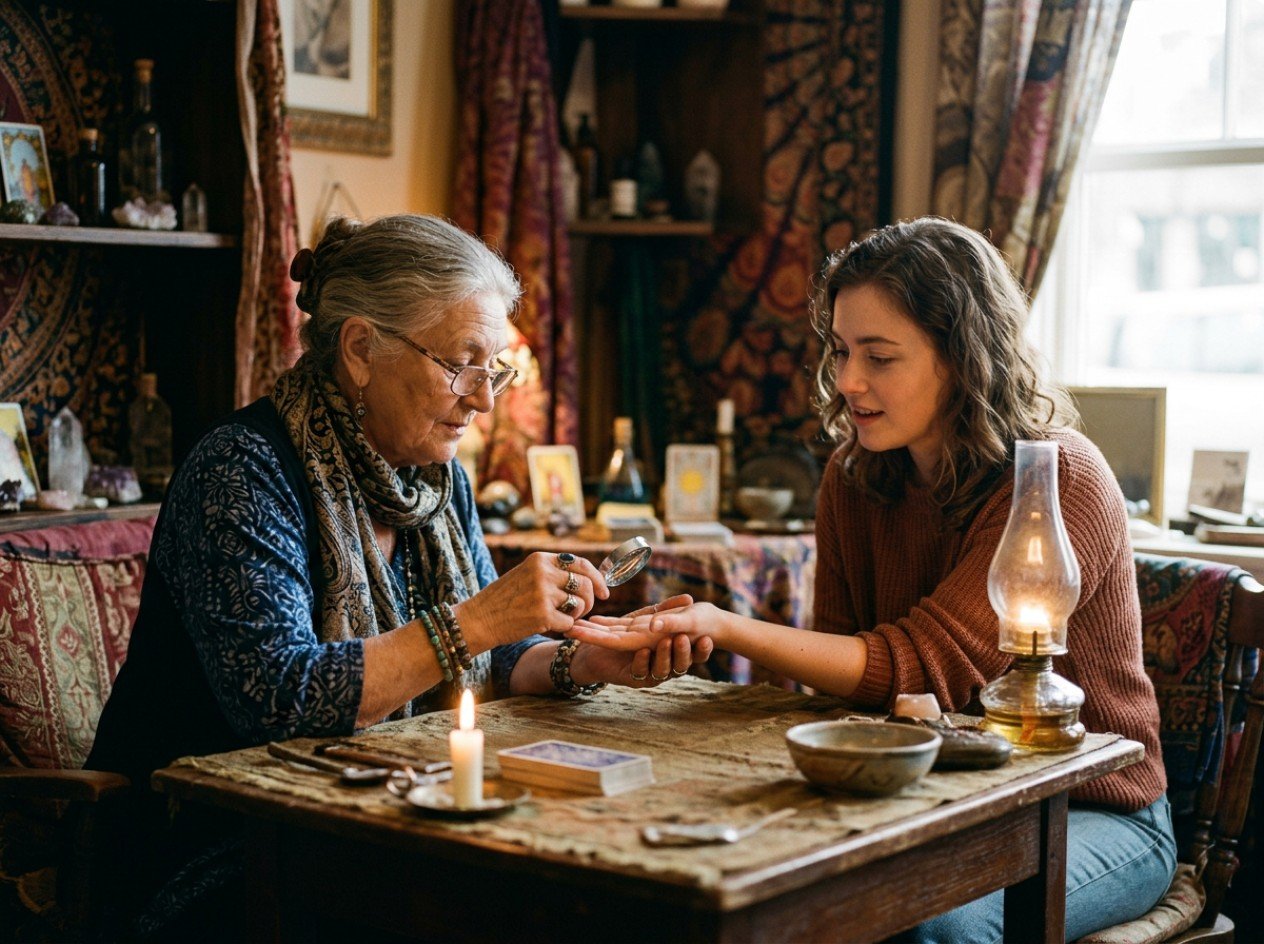
At its heart, palmistry operates through symbolism. The hand itself becomes a symbolic landscape. Rather than treating every line as a fixed prediction of future events, many experienced readers understand the hand as reflecting tendencies, characteristics, strengths, and opportunities for growth. Just as a skilled psychologist listens carefully to recurring themes within someone's life, the traditional palmist observes recurring patterns within the hand, using them as starting points for thoughtful conversation rather than absolute declarations.
The very shape of the hand carries symbolic meaning within classical palmistry. Broad, square palms with shorter fingers have traditionally been associated with practical, grounded individuals who enjoy tangible results and direct action. Long palms with slender fingers are often linked symbolically with sensitivity, imagination, creativity, and emotional awareness. Hands that combine different proportions may suggest adaptability or a balance between practical thinking and intuitive understanding. Whether or not one accepts these associations literally, they encourage us to consider how physical symbolism can stimulate psychological reflection.
Palmistry & The Four Elements
The four classical elements, Earth, Air, Fire, and Water, also appear prominently within palmistry. Earth hands are generally broad and solid, symbolising reliability, patience, and practicality. Air hands tend to feature longer fingers and are associated with communication, curiosity, and intellectual activity. Fire hands often suggest enthusiasm, confidence, and energetic action, while Water hands traditionally symbolise empathy, intuition, creativity, and emotional depth. These elemental classifications closely resemble similar symbolic systems found in astrology, ancient Greek philosophy, Ayurveda, and numerous other traditions.
Perhaps the most familiar features of the palm are its major lines. Contrary to popular belief, these are rarely interpreted as rigid predictors of fate by experienced practitioners. Instead, they represent symbolic themes unfolding throughout life. The Heart Line is associated with emotional expression, affection, empathy, and relationships. The Head Line symbolises thought processes, reasoning, learning, and decision-making. The Life Line, despite its name, is not generally understood as measuring lifespan. Rather, it symbolises vitality, resilience, adaptability, and one's engagement with life itself. The Fate Line, present more prominently in some hands than others, has traditionally been associated with vocation, direction, and the influence of external circumstances.
One reason symbolism remains so effective is that it encourages questions rather than supplying simple answers. Suppose a reader notices an especially clear Head Line. Instead of declaring, "You are highly intelligent," a thoughtful practitioner might ask how the individual approaches learning, problem-solving, or decision-making. The symbol becomes the beginning of a conversation rather than its conclusion. Good palmistry, like good counselling, often depends less upon making impressive statements than upon asking insightful questions.
Palmistry & The Mounts of the Hand
The mounts of the hand provide another fascinating symbolic system. These fleshy areas beneath the fingers are named after planetary deities familiar from Roman mythology. The Mount of Jupiter, beneath the index finger, symbolises leadership, confidence, ambition, and personal growth. Saturn's mount represents responsibility, discipline, and wisdom gained through experience. Apollo, beneath the ring finger, reflects creativity, optimism, and artistic expression. Mercury symbolises communication, adaptability, and commerce. Venus, located near the base of the thumb, is associated with affection, warmth, vitality, and appreciation for beauty. Mars represents courage and determination, while the Mount of Luna, opposite the thumb near the outer palm, symbolises imagination, dreams, intuition, and spirituality.
These planetary names illustrate beautifully how different symbolic traditions often overlap. Astrology, mythology, palmistry, and even classical psychology frequently employ similar archetypal images because they address recurring aspects of human experience. Whether expressed through a horoscope or the contours of the hand, symbols concerning courage, creativity, communication, or compassion speak to qualities recognised across cultures.
One observation I found especially interesting during my travels was that many traditional readers paid almost as much attention to flexibility as to shape. A flexible hand was often interpreted as suggesting openness to change and adaptability, while a firmer hand might symbolise persistence, consistency, or determination. Again, these observations function symbolically rather than scientifically. They encourage reflection about how we respond to life's inevitable uncertainties. Palmistry also recognises that hands change over time. This is one reason many experienced practitioners reject strictly deterministic interpretations. As people develop new skills, encounter different experiences, and mature emotionally, finer lines may become more or less prominent. Whether these physical changes possess symbolic significance remains open to interpretation, but the broader philosophical message is compelling: human beings are not static. Character develops, priorities evolve, and wisdom accumulates through experience.
Modern psychology offers an interesting perspective on why symbolic systems such as palmistry remain meaningful for many individuals. Carl Jung argued that symbolic images communicate with aspects of the psyche not always reached through purely logical analysis. Symbols invite imagination, reflection, and personal interpretation. They encourage people to explore recurring themes rather than simply categorising themselves according to fixed labels. Palmistry functions particularly well in this respect because the hands accompany us throughout every stage of life, quietly reflecting both our individuality and our shared humanity. Of course, it is important to distinguish symbolism from empirical science. Contemporary scientific research has not demonstrated that palm lines reliably predict future events or personality traits. Responsible practitioners generally present palmistry as a symbolic, reflective discipline rather than a scientifically validated predictive method. Appreciating its cultural and psychological value does not require claiming more certainty than the available evidence supports.
Palmistry: Strengs & Challenges In A Reading
One aspect of palmistry that continues to resonate with me is its emphasis upon potential rather than limitation. A thoughtful reading often highlights strengths that deserve cultivation as much as challenges requiring attention. Someone whose hand suggests strong communication skills might be encouraged to write, teach, or mediate. Another whose symbolism emphasises compassion may be drawn toward caregiving or counselling. The reading becomes aspirational rather than restrictive, inviting growth instead of imposing destiny. This emphasis mirrors many other symbolic traditions. Tarot asks us to contemplate archetypal experiences. Astrology explores recurring planetary patterns. Dreams present emotionally charged images inviting interpretation. Palmistry belongs comfortably alongside these practices because all rely upon symbolism as a language for understanding human experience. None functions best when treated as infallible prediction. Instead, they encourage thoughtful reflection, conversation, and greater self-awareness.
During my travels, I also noticed that skilled traditional readers rarely focused exclusively upon isolated features. They considered the hand as a whole. Shape, texture, flexibility, mounts, fingers, nails, major lines, and countless subtle details were interpreted together rather than separately. This holistic approach resembles anthropology itself. Cultures cannot be understood through isolated customs alone but only by appreciating the relationships connecting different aspects of social life. Likewise, symbolic systems become most meaningful when viewed as integrated wholes rather than collections of disconnected signs.
There is also something deeply human about allowing our hands to tell stories. Hands comfort children, prepare meals, build homes, create works of art, write books, plant gardens, and hold those we love. They accompany every significant stage of life. It seems entirely natural that many cultures came to regard them as symbolic maps reflecting the journeys we undertake. Whether or not one believes they reveal hidden truths, they certainly remind us of the countless ways our lives become expressed through action. The relationship between symbolism and palm reading lies not in predicting an unalterable future but in encouraging meaningful reflection. Palmistry reminds us that human beings have always searched for patterns through which to understand themselves. Its symbols invite us to consider our strengths, recognise our habits, appreciate our potential, and remain open to growth. Having studied symbolic traditions across many cultures, I have come to believe that their greatest value rarely lies in certainty. Instead, they offer thoughtful questions, beautiful metaphors, and opportunities for self-discovery. In that sense, the true wisdom of palmistry is not found solely in the lines of the hand but in the conversations those lines inspire about the lives we continue shaping every single day.