Mysticism, Nordic Runes & Norse Mythology
My first serious encounter with runes was in a graduate seminar on symbolic systems in pre-literate cultures, somewhere in the mid-nineties, in a classroom that smelled of old carpet and someone's lunch. The professor passed around facsimile photographs of runestones, weathered, massive, carved by hands that had been dust for a thousand years, and I remember feeling something that I would not have known how to name then and can only imprecisely name now: the sensation of looking at a writing system that was also something else. A tool that was simultaneously a text and a cosmology. The runes are that. Understanding why requires understanding what the Norse world thought they were looking at when they looked at a carved stone.
The Elder Futhark
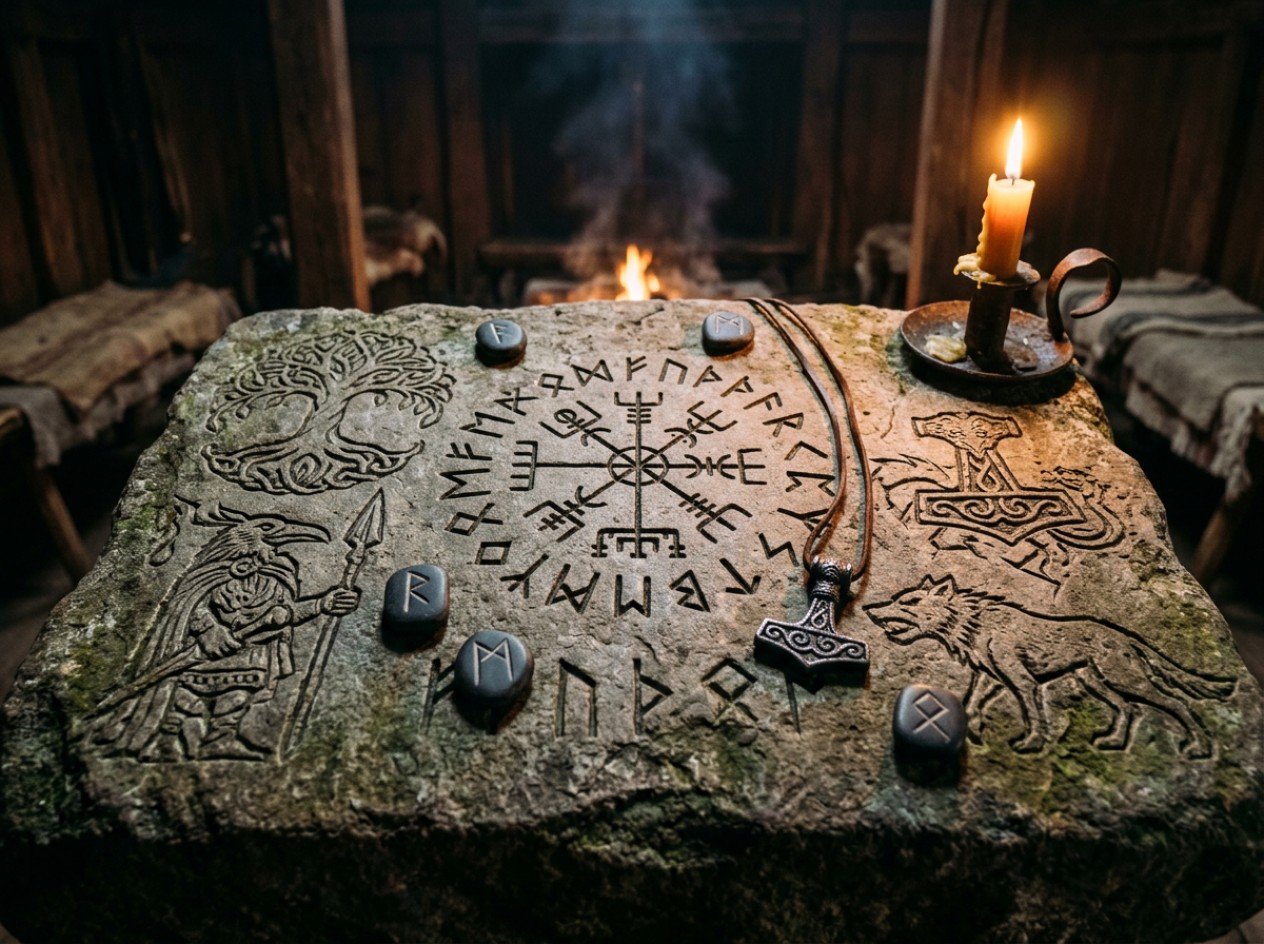
The Elder Futhark, the oldest runic alphabet, used roughly from the second to eighth centuries CE and named for its first six letters (f, u, th, a, r, k), consists of twenty-four symbols. But calling them letters, as I did just now, is already slightly misleading. The word rune comes from the Proto-Germanic *rūnō, meaning secret, mystery, or whispered counsel. The runes were not understood by the people who used them as a neutral writing system the way we understand our alphabet. They were understood as forces, cosmic principles that had been discovered rather than invented, each one carrying a specific energy that could be worked with, invoked, or read.
The mythological account of how they came to be is one of the most striking origin stories in any tradition I've encountered in thirty years of anthropological reading. In the Hávamál, one of the poems of the Poetic Edda, the collection of Old Norse texts that is our primary source for Norse mythology, Odin describes hanging himself from Yggdrasil, the world tree, for nine days and nine nights. He hangs wounded by a spear, offered to himself, without food or drink, peering downward. Then, at the moment of extremity, the runes are revealed to him, he sees them, seizes them, and falls screaming back into the world of the living. The runes are not something he creates. They are something that exists in the fabric of the cosmos, and he sacrifices himself to perceive them.
The anthropological significance of this cannot be overstated. Across cultures, the access to hidden knowledge through voluntary ordeal, fasting, isolation, physical suffering, the symbolic experience of death and return, is one of the most consistent features of shamanic initiation worldwide. Odin, in this account, is functioning as a shaman: the leader of the Norse pantheon undergoes the classic initiatory death-and-rebirth in order to bring back knowledge from the other side. What he brings back are the runes. This places them in a category not simply of sacred writing but of revealed cosmological knowledge, the kind of knowledge that is not available through ordinary means and not transmissible through ordinary speech.
The Twenty-Four Elder Futhark Runes
Each of the twenty-four Elder Futhark runes carries this weight. Fehu (ᚠ), the first rune, relates to cattle and wealth, not merely as symbols of material prosperity but as representations of the life force that circulates through the world, the energy that must be tended and shared rather than hoarded if it is to remain vital. Uruz (ᚢ) carries the energy of the aurochs, the wild ox, untamed strength, formative power, the force that shapes raw material into something. Thurisaz (ᚦ) is the rune of the giant or thorn: directed force, the energy of disruption that clears the way for new growth. Reading through the Elder Futhark this way reveals not an alphabet but a cosmological vocabulary, a set of fundamental forces that the Norse understood as constituting the fabric of existence.
This connects to something essential about Norse cosmology more broadly. The Norse world was not understood as a stable, benevolent creation presided over by an omnipotent deity. It was understood as a dynamic, contested, ultimately doomed cosmos held together through the ongoing efforts of the gods, giants, and other forces in a condition of perpetual tension. Yggdrasil, the ash tree at whose roots Odin hung, connects the nine worlds of Norse cosmology, Asgard, Midgard, Jotunheim, and the rest, and is itself perpetually under assault: gnawed at its roots by the serpent Níðhöggr, battered by the stag Eikthyrnir who eats its branches, attended constantly by the Norns, the three fate-weavers Urð, Verðandi, and Skuld, who carve runes into its bark to shape the destinies of gods and humans alike.
The Norns are worth pausing on because they illuminate something central to how runes functioned in Norse thought. Urð represents that which has become, the past, the fixed, the already-woven. Verðandi represents that which is becoming, the present, the active, the in-process. Skuld represents that which shall be, the future, the potential, the not-yet-determined. These three together constitute wyrd, the Norse concept usually translated as fate but which is more accurately understood as the web of causation that connects all events and beings. The Norns carve runes into Yggdrasil as an expression of this web. To use runes was, in some sense, to participate in the same work the Norns were doing: to inscribe meaning into the fabric of the world.
Historically, runes were used in precisely this active way. Runestones commemorated the dead and marked territory, yes, but runes were also carved onto weapons to make them more effective in battle, onto ships for protection, onto healing staves to channel curative energy. The archaeological record across Scandinavia, the British Isles, and as far east as the Black Sea shows a consistent pattern of runes used not simply to record information but to effect outcomes. The distinction we make between writing and magic did not exist for the people carving these symbols. A rune carved with intention was an act of intention made material, wyrd being shaped by a human hand.
This is, I want to be clear, anthropologically distinct from the rune practices most people encounter today in New Age or spiritual contexts. The modern use of runes as a divination system, casting rune stones, drawing runes for guidance, has a complicated history. It draws in part on genuine Norse and Germanic tradition, in part on nineteenth-century German Romanticism's reconstruction of Norse heritage, and in part on twentieth-century occultism. People like Guido von List invented runic systems and lore in the early twentieth century that had no basis in historical practice, and some of this material was unfortunately taken up by ideologically toxic movements. The serious contemporary practitioner is well served by being aware of this history rather than unconscious of it.
What survives this historical complexity, and what I find genuinely valuable, is the underlying cosmological framework. The idea that the world is constituted by identifiable forces that can be named, recognised, and engaged with, that there is a kind of literacy of reality available to those willing to study it, is one of the more interesting metaphysical proposals I know of. The runes, at their best, are a vocabulary for that literacy. Odin hung from the world tree for nine days to perceive them. That is, by any measure, a serious commitment to education. The least we can do is take what he found seriously enough to learn it carefully.