Celtic Rituals, Symbolism & Mysticism
Among the ancient cultures of Europe, few possess a legacy as rich in symbolism and ritual as the Celtic peoples. Stretching across Ireland, Scotland, Wales, the Isle of Man, Cornwall, Brittany, and parts of continental Europe, the Celts developed traditions that reflected a profound relationship with nature, the seasons, community, and the unseen world. Although much of what we know about the ancient Celts comes from archaeology, classical writers, medieval manuscripts, and surviving folklore, their symbols and rituals continue to inspire people today. Whether encountered through Celtic crosses, knotwork, seasonal festivals, or stories of Druids and sacred groves, Celtic spirituality reminds us that human beings have long sought meaning through their relationship with the land, the cycles of time, and the mysteries of existence.
It is important to begin by recognising that there was never a single unified Celtic religion. The peoples we collectively refer to as the Celts were spread across a vast geographical area and developed distinct customs, languages, and spiritual traditions over many centuries. The beliefs of Iron Age Gaul differed in various respects from those of early medieval Ireland or Scotland. Nevertheless, recurring themes appear throughout Celtic culture, including reverence for nature, cyclical understandings of time, respect for ancestors, and the belief that the visible and invisible worlds exist in close relationship with one another.
Nature occupied the very heart of Celtic spirituality. Forests, rivers, mountains, lakes, springs, and ancient trees were not simply scenic locations but places of profound spiritual significance. Rather than separating the sacred from the natural world, the Celts frequently understood divine presence as woven throughout creation itself. Certain locations were regarded as especially powerful because they represented meeting places between the human and spiritual realms. Sacred wells, standing stones, hilltops, and groves often became centres for ritual, prayer, and seasonal celebration.
Celtic Symbolism & Trees
Trees possessed particular symbolic importance. The mighty oak, from which the word "Druid" may possibly derive through ancient Indo-European linguistic roots associated with oak and knowledge, symbolised strength, endurance, wisdom, and stability. Yew trees, capable of living for thousands of years, became associated with death, rebirth, and continuity between generations. Rowan trees were frequently regarded as protective, while ash trees often symbolised connection between heaven, earth, and the underworld. These associations varied across regions, yet they reveal how closely the Celts observed the natural characteristics of the living world.
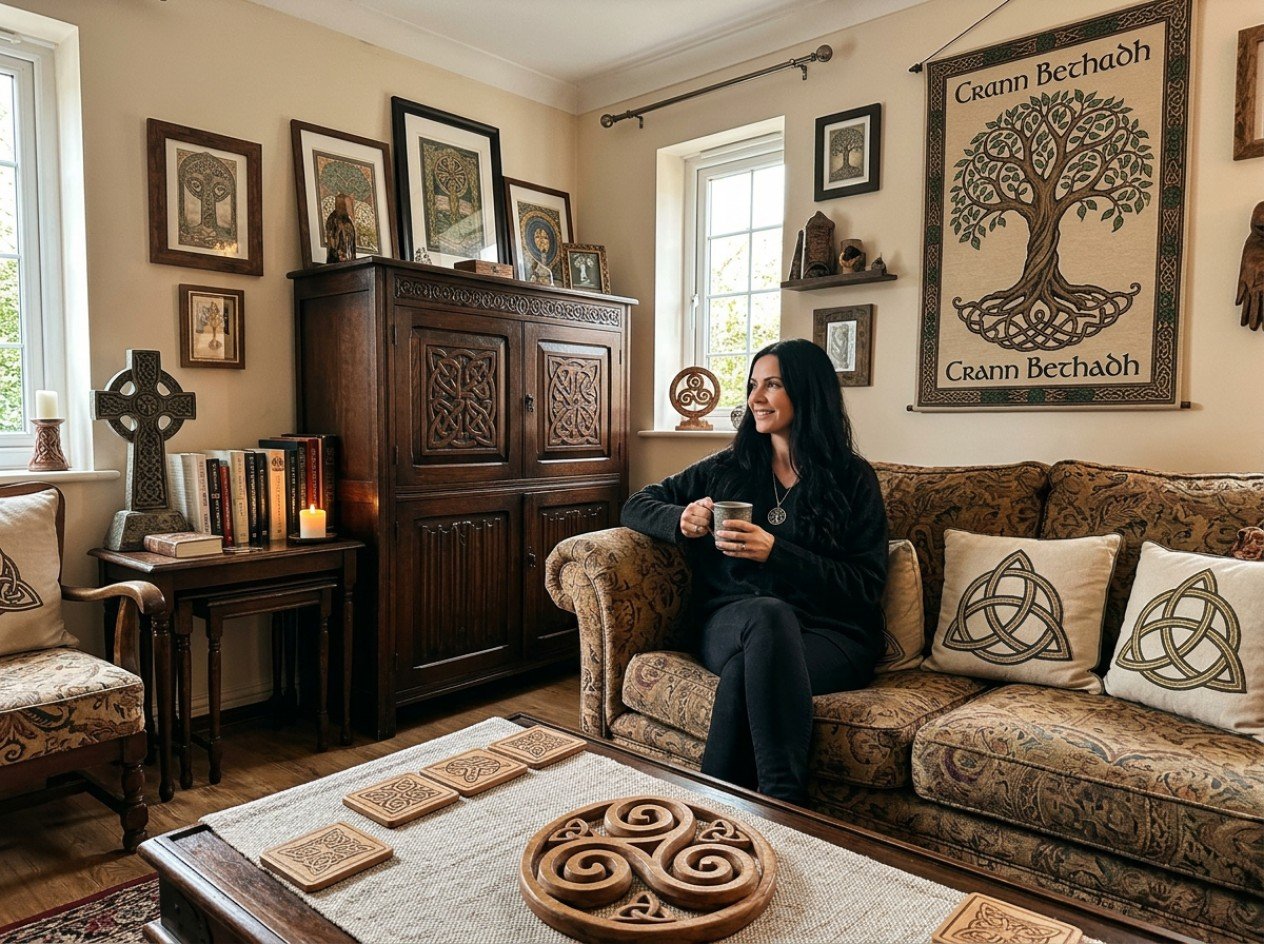
Perhaps the best-known visual expression of Celtic symbolism is the Celtic knot. These endlessly interwoven patterns contain no obvious beginning or end, making them powerful symbols of eternity, continuity, and the interconnectedness of existence. Although many of the elaborate knot designs familiar today developed within early Christian manuscripts such as the Book of Kells, their underlying themes resonate strongly with earlier Celtic ideas concerning cycles, unity, and the ongoing relationship between life, death, and renewal. Modern interpretations often see Celtic knots as symbols of eternal love, family, friendship, or spiritual interconnectedness.
The spiral represents another important Celtic symbol. Single spirals, double spirals, and triple spirals appear frequently within prehistoric monuments such as Newgrange in Ireland, predating the historical Celts yet influencing later Celtic artistic traditions. Spirals often symbolise growth, transformation, expansion, and life's continual movement. The triple spiral, or triskele, has been interpreted in numerous ways, representing concepts such as land, sea, and sky; birth, life, and death; or body, mind, and spirit. Like much ancient symbolism, its precise meaning probably varied depending upon context.
The Celtic Cross & Christianity
The Celtic cross beautifully illustrates the blending of older traditions with Christianity. While the familiar ring surrounding the cross is often interpreted as representing eternity, the sun, or divine unity, historians continue debating its precise origins. Whatever its historical development, the Celtic cross became one of the most recognisable symbols of Irish and Scottish Christianity, combining Christian theology with artistic traditions already deeply rooted within Celtic culture.
Animals also occupied an important place within Celtic symbolism. The stag frequently represented nobility, renewal, and the untamed beauty of the forest. Ravens and crows appeared in myths associated with prophecy, warfare, and transformation. Salmon symbolised wisdom, particularly in Irish mythology where the Salmon of Knowledge granted extraordinary understanding to the hero Fionn mac Cumhaill. Horses represented strength, fertility, sovereignty, and freedom, while boars often symbolised courage and determination. These symbolic associations reflected careful observation of nature rather than arbitrary invention.
One of the defining features of Celtic spirituality was its cyclical understanding of time. Rather than viewing the year simply as a sequence of months, the Celts celebrated seasonal festivals marking important transitions within both nature and community life. Four major festivals formed the traditional Celtic calendar: Samhain, Imbolc, Beltane, and Lughnasadh, each reflecting significant agricultural and spiritual turning points.
Samhain, celebrated around the beginning of November, marked the end of the harvest and the beginning of winter. It was regarded as a liminal period when the boundary between the human world and the Otherworld became especially thin. Ancestors were remembered, protective fires were lit, and communities prepared for the challenges of winter. Modern Halloween contains several customs that ultimately trace aspects of their history to Samhain, although contemporary celebrations differ considerably from ancient observances.
The Celtic Gods
Imbolc, celebrated around the beginning of February, welcomed the first signs of returning spring. Associated in later tradition with Saint Brigid and earlier with the goddess Brigid, Imbolc symbolised purification, inspiration, healing, and hope. Candles, fresh water, and the gradual return of light became central themes. The festival encouraged people to prepare both practically and spiritually for the coming growing season.
Beltane, celebrated around the beginning of May, marked the arrival of summer and the flourishing of life. Bonfires, dancing, flowers, and community celebrations expressed gratitude for fertility, abundance, and renewal. Livestock were sometimes ceremonially guided between protective fires, symbolising blessing and purification before summer grazing. Beltane remains one of the most joyful and widely celebrated festivals within contemporary Celtic-inspired spiritual traditions.
Lughnasadh, observed around the beginning of August, honoured the first harvest and the god Lugh, associated with craftsmanship, skill, and kingship. Communities gathered for feasting, athletic competitions, markets, storytelling, and celebrations expressing gratitude for the year's abundance. Like many harvest festivals worldwide, Lughnasadh reminded participants of humanity's dependence upon both natural cycles and communal cooperation.
The Druids occupy an especially fascinating place within discussions of Celtic ritual, although much about them remains uncertain. Classical Roman writers described Druids as religious leaders, judges, teachers, philosophers, and advisors. They appear to have memorised extensive bodies of knowledge rather than relying heavily upon written texts. Because much of what survives was written by outsiders, historians continue carefully evaluating ancient accounts while avoiding romantic exaggeration. What seems reasonably clear is that Druids played important roles within religious ceremonies, legal matters, education, and preserving cultural memory.
Ritual itself served multiple purposes within Celtic communities. Ceremonies marked births, marriages, deaths, seasonal transitions, harvests, and important communal events. Rituals strengthened social bonds while helping individuals navigate periods of uncertainty and change. Like rituals across many cultures, they transformed ordinary moments into meaningful occasions by connecting personal experience with larger patterns of nature and tradition.
The Otherworld occupies another important place within Celtic mythology. Unlike concepts of heaven and hell found in some later religious traditions, the Celtic Otherworld often appears as a place of beauty, abundance, wisdom, and timelessness existing alongside the ordinary world rather than entirely separate from it. Heroes occasionally entered this realm through caves, lakes, mounds, or mysterious islands before returning transformed by their experiences. Symbolically, these journeys represent encounters with deeper wisdom and personal transformation.
Hospitality also possessed sacred significance. Welcoming strangers, sharing food, and offering protection reflected important moral obligations throughout Celtic society. Stories frequently portray hospitality as revealing character, while failures of generosity often carried serious consequences. These traditions remind us that spirituality extended beyond ritual alone into everyday ethical conduct.
One reason Celtic symbolism continues attracting interest today is its emphasis upon interconnectedness. Modern life often encourages fragmentation—separating work from home, humanity from nature, and practical concerns from spiritual reflection. Celtic traditions invite a different perspective. The changing seasons, the movement of rivers, the growth of trees, and the rhythm of community life all participate within one continuous pattern. Human beings belong within this living network rather than standing apart from it.
Modern environmental movements have sometimes found inspiration in this aspect of Celtic thought. Although it would be inaccurate to project contemporary ecological ideas directly onto ancient societies, Celtic reverence for sacred landscapes reminds us that respectful relationships with nature have deep historical roots. Caring for forests, rivers, wildlife, and agricultural land becomes not merely practical stewardship but an expression of gratitude toward the living world.
At the same time, it is important to distinguish between historical Celtic religion and modern Celtic-inspired spirituality. Contemporary Druidry, Neo-Pagan traditions, and other modern spiritual movements often draw inspiration from ancient Celtic beliefs while adapting them to present-day values and understanding. These practices represent living spiritual paths rather than exact reconstructions of Iron Age religion. Appreciating both the historical evidence and the creative development of modern traditions allows for a more balanced understanding.
The symbolism and rituals of Celtic culture continue speaking to people because they address enduring human concerns. They remind us that life unfolds in cycles rather than straight lines; that endings frequently prepare the way for new beginnings; that community strengthens individuals; that nature offers both practical sustenance and spiritual inspiration; and that mystery remains an essential part of human existence. Whether expressed through the endless lines of a Celtic knot, the quiet dignity of an ancient oak, the lighting of a seasonal fire, or the telling of stories passed lovingly between generations, Celtic spirituality encourages us to live with greater awareness of our connections—to one another, to the natural world, to our ancestors, and to the timeless rhythms that continue shaping human life. In an increasingly fast-paced world, that invitation to pause, observe, and rediscover our place within the larger tapestry of existence may be one of Celtic culture's most enduring gifts.