


Sufism & Mysticism
Sufism is one of the richest and most influential mystical traditions within Islam, yet it is also one of the most widely misunderstood. For some, the word immediately conjures images of whirling dervishes gracefully turning in meditation. For others, it evokes poetry, music, or stories of saints who devoted their lives to seeking a closer relationship with God. While these associations certainly form part of the Sufi tradition, they only scratch the surface. At its heart, Sufism is a path of spiritual refinement. It seeks not merely to understand religious teachings intellectually but to experience them inwardly through love, contemplation, humility, and the transformation of the self. Understanding Sufism therefore requires us to appreciate both its place within Islamic history and its broader contribution to mystical thought.
The Origins of Sufism
The origins of Sufism can be traced back to the earliest generations of Muslims following the death of the Prophet Muhammad in the seventh century. During this period, many believers sought to emulate not only the Prophet's outward actions but also his inner devotion, humility, compassion, and complete trust in God. As Islam expanded rapidly across the Middle East, North Africa, and beyond, some individuals became concerned that increasing political power and material prosperity might distract believers from the spiritual heart of their faith. These early ascetics chose lives of simplicity, prayer, fasting, charity, and contemplation, laying the foundations of what would later become known as Sufism.
The precise origin of the word "Sufi" remains the subject of scholarly discussion. One widely accepted explanation connects it to the Arabic word suf, meaning "wool," referring to the simple woollen garments worn by early ascetics as symbols of humility and detachment from worldly luxury. Other scholars have suggested links to the word safa, meaning purity, reflecting the Sufi emphasis upon purifying the heart. Regardless of its linguistic origins, the term eventually came to describe individuals dedicated to cultivating an intimate awareness of God's presence in every aspect of life.
During the eighth and ninth centuries, Sufism gradually evolved from an individual ascetic movement into a more structured spiritual tradition. Influential figures such as Hasan al-Basri emphasised repentance, moral discipline, and sincere devotion, while Rabia al-Adawiyya introduced one of Sufism's most enduring themes: divine love. Rabia famously taught that God should be loved not out of fear of punishment or hope for reward, but simply because God is worthy of love. This profound shift placed love, rather than obligation, at the centre of spiritual life and would profoundly influence generations of Sufi thinkers.
Sufism - A Development In Theological and Philosophical Thinking
By the tenth and eleventh centuries, Sufism had developed sophisticated theological and philosophical foundations. Scholars such as Junayd of Baghdad argued that genuine mystical experience should remain firmly rooted within Islamic belief and practice. Rather than existing outside orthodox Islam, Sufism was understood as its inward dimension, complementing Islamic law and theology by focusing upon the purification of the heart. This balanced approach helped establish Sufism as an integral component of Islamic civilisation rather than an alternative religious movement.
Perhaps one of the most important concepts in Sufism is the journey toward spiritual purification. Sufis often describe the human heart as capable of reflecting the Divine, much like a polished mirror reflects light. However, selfishness, pride, anger, greed, and excessive attachment to worldly concerns gradually obscure that reflection. Through prayer, remembrance of God, ethical living, humility, and disciplined self-examination, the individual seeks to polish the heart until it becomes increasingly receptive to divine presence. This process is not viewed as achieving perfection but as engaging in lifelong spiritual refinement.
Sufism, Dhikr & Rememberance
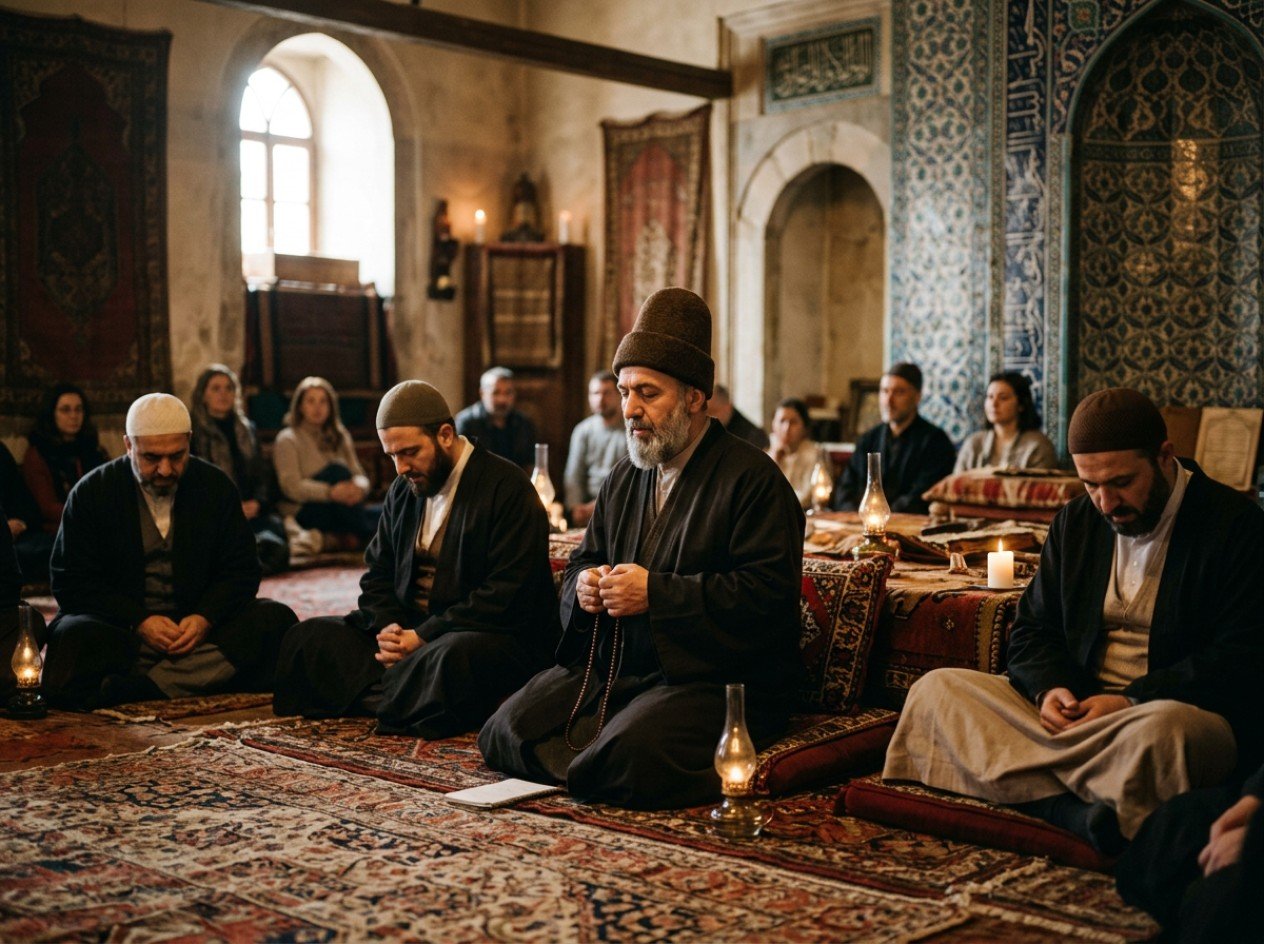
Central to this process is the practice known as dhikr, often translated as "remembrance." Dhikr involves the repeated recitation of the names of God, passages from the Qur'an, or short devotional phrases intended to cultivate constant awareness of the Divine. Depending upon the particular Sufi order, dhikr may be practiced silently during meditation or collectively through rhythmic chanting, controlled breathing, and coordinated movement. The purpose is not merely repetition but the gradual transformation of consciousness, allowing the individual to become increasingly mindful of God's presence throughout daily life.
Sufism is also renowned for its extraordinary literary tradition. Few mystical movements have produced such a wealth of poetry, philosophy, and spiritual reflection. The Persian poet Jalal al-Din Rumi remains perhaps the best-known Sufi writer in the modern world. His poetry celebrates love, longing, unity, and the soul's journey toward God with remarkable emotional depth. Alongside Rumi stand other influential figures such as Hafiz, Attar of Nishapur, Saadi, and Ibn Arabi, each contributing distinctive insights into the nature of spiritual experience. Their writings continue to inspire readers across religious and cultural boundaries because they explore universal questions concerning love, identity, purpose, and transcendence.
One of Ibn Arabi's most influential ideas concerns what later scholars described as the "Unity of Being." While interpretations of his writings vary considerably, he suggested that all existence ultimately depends upon and reflects the reality of God. Such ideas have generated extensive philosophical discussion within Islamic scholarship for centuries. Importantly, Sufi metaphysics should not be understood as denying the distinction between Creator and creation but as exploring the profound dependence of all existence upon the Divine.
Sufism & The Whirling Dervish
The famous "whirling dervishes" belong to the Mevlevi Order, established in the tradition inspired by Rumi. Their graceful turning ceremony, known as the Sema, is perhaps the most widely recognised symbol of Sufism in popular culture. Yet it is frequently misunderstood as a performance or spectacle. Within the tradition itself, the ceremony represents a form of moving meditation. The turning symbolises the soul's spiritual journey toward God, while the circular movement reflects the harmonious order of creation itself. Every gesture within the ritual carries symbolic meaning rooted in centuries of spiritual teaching.
As Sufism expanded throughout the Islamic world, organised brotherhoods known as tariqas, or spiritual paths, emerged. Each tariqa developed its own practices, lineage of teachers, and methods of spiritual instruction while remaining grounded in Islamic belief. These orders played significant roles in education, charity, scholarship, diplomacy, and community life across regions stretching from Morocco and Egypt to Turkey, Central Asia, India, Indonesia, and sub-Saharan Africa. Through trade, travel, and missionary activity, Sufi teachers helped spread Islam peacefully into many regions by emphasising compassion, service, and personal example.
The relationship between Sufism and Islamic orthodoxy has not always been without tension. Throughout history, some scholars expressed concern that certain mystical practices or philosophical interpretations risked departing from mainstream Islamic teachings. At the same time, many respected Islamic theologians, including Al-Ghazali, argued that Sufism represented the essential spiritual heart of Islam when practiced within appropriate theological boundaries. Al-Ghazali's writings proved enormously influential by demonstrating that intellectual scholarship and mystical devotion could complement rather than contradict one another.
From a broader academic perspective, Sufism illustrates many characteristics shared by mystical traditions across cultures. Like Christian contemplatives, Jewish Kabbalists, Hindu yogis, and Buddhist meditators, Sufis seek transformation through disciplined spiritual practice rather than mere intellectual knowledge. Yet Sufism remains distinctly Islamic in its foundation. Its teachings emerge directly from the Qur'an, the example of the Prophet Muhammad, and centuries of Islamic scholarship. Appreciating this context helps avoid the common misconception that Sufism exists independently of Islam.
In the contemporary world, Sufism continues to attract interest from both Muslims and non-Muslims alike. Its emphasis upon compassion, humility, self-discipline, and divine love resonates with many people seeking deeper spiritual meaning amid the complexities of modern life. While popular culture sometimes romanticises Sufism by focusing exclusively on poetry or mystical experience, serious study reveals a disciplined tradition rooted in ethical living, rigorous self-examination, and devotion to God.
Ultimately, Sufism reminds us that religious life involves both outward practice and inward transformation. It teaches that spiritual maturity cannot be measured solely by external observance but also by the qualities that gradually emerge within the individual: patience, generosity, honesty, humility, gratitude, and love. Whether approached from the perspective of history, theology, philosophy, or comparative mysticism, Sufism offers a profound example of humanity's enduring search for deeper spiritual understanding. Its enduring legacy lies not merely in its poetry or rituals, but in its invitation to cultivate a heart capable of reflecting compassion, wisdom, and an ever-deepening awareness of the Divine.