Ancient Scottish Rituals & Mysticism
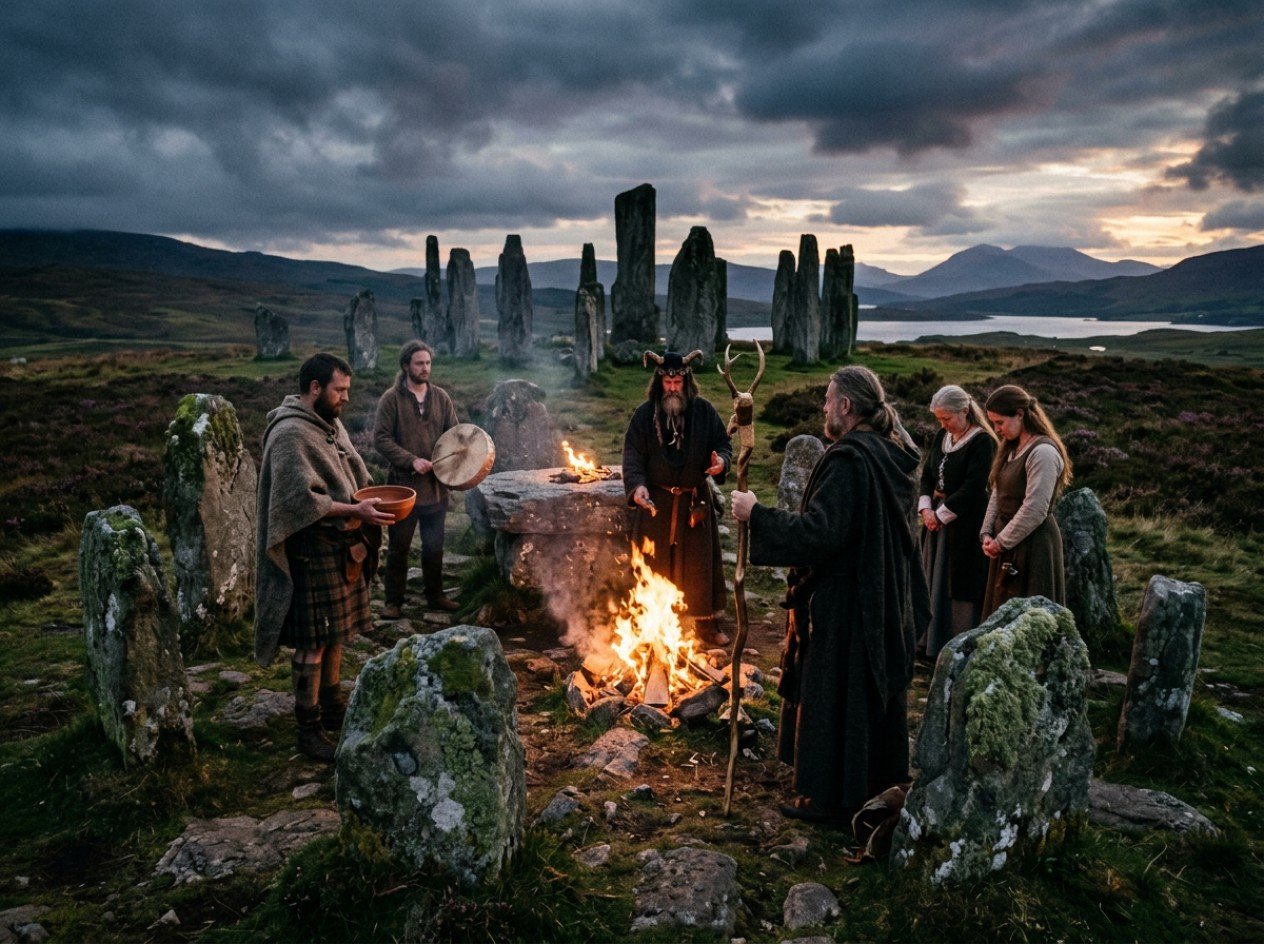
Scotland is one of those places I keep returning to in my research, not just because the landscape itself seems to demand a certain quality of attention, though it does, and anyone who has stood on the Orkney mainland at dawn and looked at the Ring of Brodgar rising from the mist knows exactly what I'm talking about, but because Scottish ritual practice sits at one of the most fascinating intersections I've encountered in thirty plus years of comparative work I've engaged in. It is a place where Celtic animism, Norse influence, early Christian overlay, Highland clan culture, and a particular Scottish quality of psychological directness about death and the sacred have all compressed into a ritual tradition that is simultaneously ancient and stubbornly, unexpectedly alive.
Let me begin by looking at the landscape itself, because in Scottish ritual tradition, as in most of the traditions I study comparatively, the landscape is not the backdrop to the ritual. The landscape is the ritual's primary actor. The Scots, and particularly the Highland and Island communities that preserved the oldest practices, understood their land as inhabited, not metaphorically, not as a poetic way of speaking, but as a genuine ontological claim. The hills had presences. The lochs had temperaments. The crossroads and the threshold places between land and water, between hill and valley, between the living settlement and the wild beyond it, were places where the boundaries between the ordinary world and what Gaelic tradition calls an saol eile, the other world, were thin enough to permit movement in both directions. This is structurally identical to what anthropologists have documented in Shinto tradition in Japan, in West African animist practice, in the indigenous cultures of the Pacific Coast where I live and work. The specific geography changes but the ontological structure is remarkably consistent i.e., the world is not inert matter awaiting human meaning but a field of presences with which human beings must maintain active, ritual relationship.
An Caol áit
The Scots called the liminal times, the thresholds between one state and another, an caol áit, the thin places. This phrase has been somewhat sentimentalised in Celtic spirituality circles, turned into a vague synonym for anywhere that feels atmospheric or emotionally affecting. The original usage was more precise and more serious. The thin places were specific locations at specific times: dawn and dusk, the first days of the quarter festivals, the edges of land and water, the spaces around death. They were not simply beautiful. They were structurally dangerous in the way that all genuine liminality is dangerous, they exposed the person standing in them to realities and forces that ordinary social structures protect against. The ritual traditions that developed around thin places were not decorative. They were protective technologies for navigating genuine exposure to the non-ordinary.
The four quarter festivals of the Gaelic calendar, Samhain, Imbolc, Bealltainn, and Lùnastal, are the most widely known element of this tradition, largely because they have been absorbed into the broader Celtic spirituality and Wiccan revival movements of the twentieth century. What tends to get lost in that absorption is the specifically Scottish quality of these observances, which is considerably less concerned with fertility and seasonal celebration than their contemporary versions suggest and considerably more concerned with the management of the dead, the negotiation with the spirit world, and the maintenance of the household as a ritual unit. Samhain in the Highland tradition was not primarily a harvest festival. It was the night when the dead returned, when the boundary between the living and the dead collapsed entirely, when offerings had to be made and precautions taken and the household fire allowed to go out and be relit from the communal bonfire as a way of symbolically reconstituting the community's relationship with the forces that sustained it. The structural parallel with Día de los Muertos in Mexico, with the Japanese Obon festival, with the Roman Lemuria, is not coincidental. It reflects a cross-cultural recognition of what Victor Turner called the danger and the productivity of liminality, the fact that the moments when ordinary structures dissolve are simultaneously the moments of greatest peril and greatest possibility.
The Bean-Nighe
The ritual tradition I find most anthropologically distinctive in a Scottish context is the bean-nighe, that is. the washerwoman at the ford. She appears in Highland folklore across multiple centuries of documentation as a small, supernatural woman washing bloodied clothing in a stream, visible to those about to die. She is usually understood as a harbinger of death, a kind of Scottish banshee, but the deeper ritual significance is more interesting than this. The ford, in Scottish as in many Indo-European ritual traditions, is a liminal space par excellence: the crossing point between one territory and another, between the living and the dead, between the known and the unknown. The act of washing, of purification, of preparation, is a ritual act in virtually every tradition I've studied. The bean-nighe is not simply predicting death. She is performing the preparatory ritual that makes the crossing possible. She is the liminal functionary at the liminal place, doing the liminal work. Her appearance signals not just that someone will die but that the ritual apparatus of the other world is already in motion, already preparing the passage.
The Highland tradition of the death rites, the ritual washing of the body, the keeping of the wake, the specific prohibitions around mirrors and the behaviour of animals in the presence of the dead, represents one of the most elaborated ritual complexes in the Scottish tradition, and one that persisted in recognisable form well into the twentieth century in the Hebrides. What strikes me, comparing it with death ritual traditions in other cultures, is the degree to which it is concerned with maintaining the integrity of the boundary between the living and the dead while simultaneously keeping that boundary permeable enough to allow appropriate exchange. The dead are not simply removed and mourned. They are managed, kept present long enough for the proper ritual closure, then released in a way that prevents their return as something dangerous. This is, structurally, exactly what I have observed in death ritual traditions in rural Japan and in the Toraja highlands of Sulawesi. The specific forms are radically different. The underlying problem being solved, how to maintain relationship with the dead without being colonised by the dead, is identical.
The Cailleach
I want to say something about the Cailleach before I close, because she is the figure in Scottish ritual tradition who most consistently arrests my attention as a comparative ritual scholar. The Cailleach, the Old Woman, the Hag, is a pan-Gaelic and pan-Scottish figure who controls the weather and the seasons, who shaped the landscape by dropping boulders from her apron, who is simultaneously creator, destroyer, and transformer. She is not evil. She is not benevolent. She is, in the precise technical sense, a liminal figure: she stands at the threshold between categories rather than firmly within any of them. She is old and she is powerful. She destroys and she renews. She is the winter that precedes the spring and the death that precedes the rebirth. Comparable figures appear in Norse mythology, in Slavic tradition, in the Hindu concept of Kali. What they share is the ritual recognition that genuine transformation, not the comfortable, manageable change of ordinary life but the radical, ego-dissolving transformation that genuine initiation requires, comes through the terrifying feminine rather than the reassuring one. The Cailleach is not there to comfort you. She is there to transform you, whether you are prepared or not.
This is, I think, what Scottish mystical ritual tradition at its most serious is really about. Not the romanticised heather-and-mist version that fills airport bookshops and tourist centres, though that version has its own kind of truth. The real tradition is about the management of genuine danger, the danger of the thin places, the danger of the dead, the danger of a landscape that is not neutral, the danger of a transformation that does not leave you intact. It survived centuries of suppression, first by early Christianity's genuine discomfort with its animist ontology, then by the calculated destruction of Highland culture after 1746, because it was answering questions that no amount of suppression has ever made irrelevant. How do we live in a world that is not merely material? How do we maintain relationship with the dead? How do we survive the passages that genuinely transform us? Scotland developed some of the most rigorous answers to these questions that I know of. They deserve to be taken seriously on their own terms.