


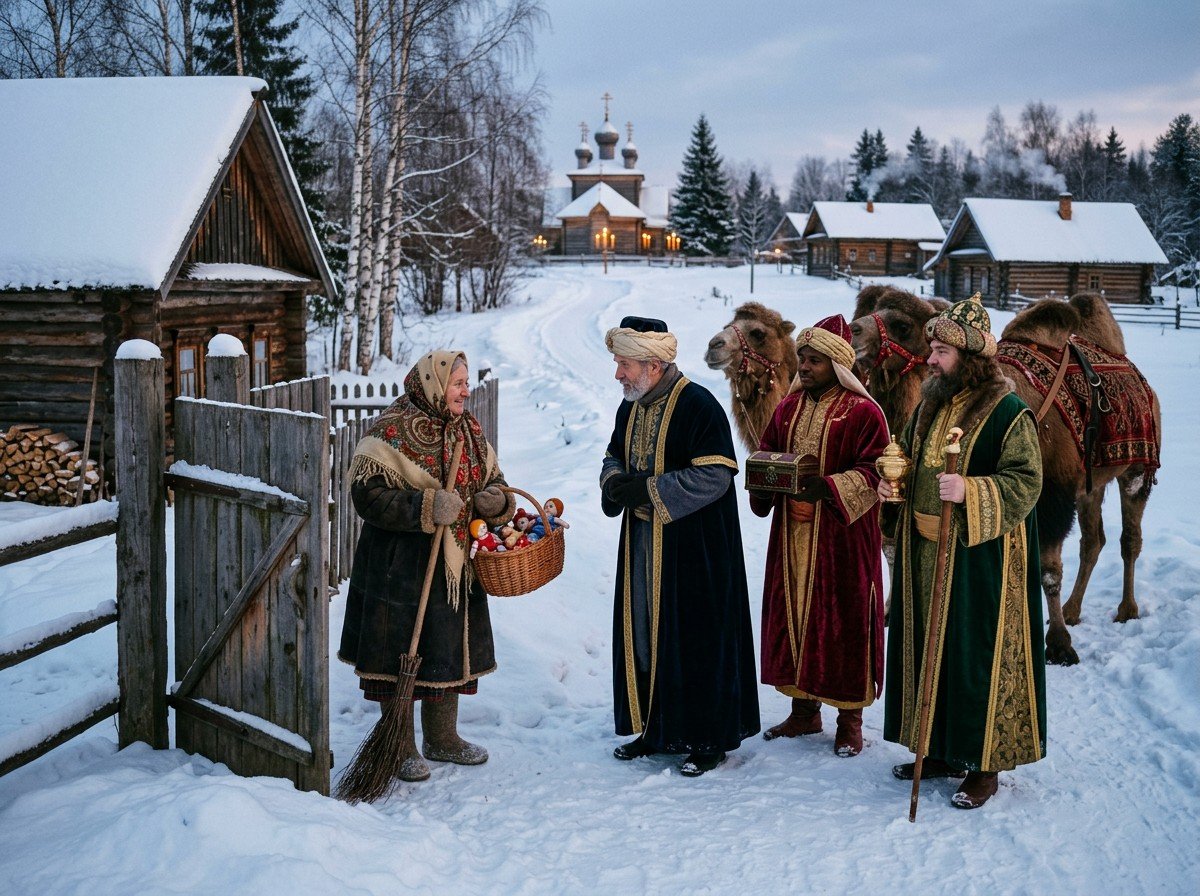
The Russian Christmas Story of Babushka
There is an uncomfortable scholarly truth at the heart of the Babushka legend that I feel obligated to address before we go any further, because I think it actually makes the story more interesting rather than less. The version of the tale most widely circulated in the West, the kindly old Russian grandmother who delays following the Magi to the Christ child because she has housework to finish, then spends eternity wandering in search of the child she missed, leaving gifts for sleeping children along the way, was almost certainly not an ancient Russian folk tradition at all. It was in all probability written by an American poet named Edith Matilda Thomas and published in 1907. Russian visitors to Western websites about the story consistently report having never heard it before. The legend of Babushka, as a piece of Russian Christmas folklore, is largely a Western construction of what Russian Christmas folklore ought to look like.
I want to take a moment for that to sink in before proceeding, because it raises a question that is central to the study of religion and religious narrative i.e., does the likely manufactured origin of a story disqualify it from serious theological or spiritual consideration? My answer, after thirty years in this field, is emphatically no. Christianity has absorbed, transformed, and reinterpreted narratives from dozens of pre-existing cultural traditions, and the process by which a story becomes spiritually significant is not dependent on its being ancient or ethnically authentic. What matters is what the story does, what spiritual work it performs, what theological themes it carries, what it illuminates about the human condition and its relationship to the sacred. The Babushka legend, whatever its origins, does genuine and interesting theological work that is worth examining carefully.
The Missed Encounter With The Divine
The structural core of the story is the missed encounter with the divine. Babushka is invited by the Magi to accompany them to the Christ child. She declines, not from malice or unbelief, but from the most recognisably human of reasons: she has things to do. The house needs cleaning. She wants to find a proper gift. She will come tomorrow. By the time she is ready, the star is gone and the kings have moved on. The theological weight of this moment is immense, and it is thoroughly continuous with a central preoccupation of Russian Orthodox Christian spirituality: the tragedy of the soul that glimpses the divine and then turns away, not in dramatic rejection but in the quiet distraction of ordinary life. The Philokalia, the great collection of Eastern Christian ascetic and mystical texts compiled primarily in the eighteenth century, returns again and again to this theme i.e., the nous, the spiritual intellect, is capable of apprehending God directly, but it is constantly drawn away by the logismoi, the intrusive thoughts and anxieties of worldly preoccupation. Babushka's housework is not a trivial detail. It is a precise symbol for the condition of the uncontemplated soul.
The Russian Orthodox tradition has always placed particular emphasis on what the Greek Fathers called theosis, the process of divinisation, by which the human being is progressively transformed into the likeness of God through prayer, sacrament, and ascetic practice. Theosis is not a single moment of conversion but a lifelong journey, and the journey can be interrupted, delayed, or diverted by attachment to things that are, in themselves, innocent and even good. Babushka is not a sinner in any dramatic sense. She is hospitable to the Magi, she prepares gifts, she sets out eventually to follow. Her tragedy is the tragedy of the almost, of the soul that was close enough to touch the sacred and allowed the moment to pass. This is a more sophisticated spiritual teaching than the simple morality tale it might appear to be, and it resonates with the Orthodox insistence that the spiritual life demands a quality of watchful attention, nepsis, sobriety of spirit, that most of us are only intermittently capable of.
Babushka Wanders Forever
The ongoing wandering that follows Babushka's missed encounter is the story's most theologically rich dimension. She is neither damned nor saved in any conventional sense. She wanders forever, looking for the child in the face of every sleeping child she encounters, leaving gifts. This is, in the vocabulary of Orthodox mysticism, a form of perpetual pilgrimage, the soul in ceaseless motion toward a sacred encounter it cannot quite reach. There are structural parallels here with the figure of the Wandering Jew in European Christian legend, but also with the Orthodox understanding of this earthly life as fundamentally a state of pilgrimage and exile, the soul not yet at home in the divine presence it was created for. The icons of the Russian Orthodox tradition are saturated with faces looking not at the viewer but through them, toward something behind and beyond the material world. Babushka, perpetually seeking the child she missed, is in some sense the condition of every soul in its earthly pilgrimage: always looking, never quite arriving.
The detail of her leaving gifts for sleeping children deserves attention, because it connects the story to one of the most theologically significant practices in Russian Orthodox tradition: the anonymous gift. Russian Orthodox spirituality has always placed considerable weight on almsgiving and charity performed without recognition, the left hand not knowing what the right hand does, in the Gospel formulation. Babushka leaves her gifts while the children sleep, unseen and unacknowledged. This is not merely the mechanism of a charming gift-giving legend. It is a practice of the theological virtue of kenosis, self-emptying, the giving of self without expectation of return, that is among the most distinctively Eastern Christian spiritual emphases. The great nineteenth-century Russian staretz, the spiritual elders whose tradition of mystical counsel is one of Orthodoxy's most profound gifts to Christian spirituality, consistently directed their disciples toward this kind of self-effacing charity as a path toward theosis.
Babushka & Orthodox Christianity
Whether or not the story is genuinely ancient Russian, it has been absorbed into the broader spiritual imagination of Orthodox Christianity in ways that are structurally coherent with Orthodox theological concerns, and that absorption is itself religiously significant. Comparable figures exist in other Christian traditions: Italy's La Befana is the most direct parallel, an old woman who also delayed following the Magi and also wanders eternally seeking the Christ child, leaving gifts for children on Epiphany night, January sixth, which is also the day the Orthodox calendar traditionally associates with the visit of the Magi. The convergence of these legends across different Christian traditions suggests that whatever their specific origins, they are crystallising around a shared theological problem: the soul's relationship to the divine encounter it simultaneously desires and defers.
I teach a course on mysticism and narrative in which I use the Babushka story specifically because it unsettles students' assumptions about what counts as authoritative religious tradition. The story is probably not old. It is probably not Russian in any simple ethnic sense. It is almost certainly not what most people think it is. And yet it is, in the most serious theological sense, a genuinely Orthodox story, one that thinks through, with considerable precision, the spiritual problem of the distracted soul, the missed encounter, the perpetual seeking that follows from the grace we failed to receive at the moment it was offered. The grandmother in the legend is not a cautionary tale. She is a mirror. Most of us recognise ourselves in her rather too easily. That recognition is, I think, exactly what the best religious narrative is for.