

The Hindhu Religion & Mysticism
Living on the East Coast has given me a wonderful appreciation for history. Whether walking through the colonial streets of Boston, visiting old churches in New England, or exploring museums in New York and Washington, I'm constantly reminded that traditions evolve over centuries rather than appearing overnight. That perspective has always shaped the way I approach the study of religion. Few religious traditions demonstrate this better than Hinduism. Often described as the world's oldest living religion, Hinduism represents not a single system of beliefs but an extraordinary collection of philosophies, rituals, spiritual practices, and mystical traditions that have developed over thousands of years. At its heart lies a profound exploration of some of humanity's oldest questions: Who are we? Why are we here? What is the nature of reality? And how might we experience a deeper relationship with the Divine?
One of the first things to understand about Hinduism is that it differs significantly from many Western religious traditions. Rather than being founded by a single historical figure at a specific moment in time, Hinduism developed gradually over many centuries on the Indian subcontinent. Its earliest roots are often traced to the Vedic period, beginning around 1500 BCE, although many scholars believe aspects of Hindu culture extend even further back. The sacred writings known as the Vedas, among the oldest religious texts still studied today, laid much of the foundation upon which later Hindu philosophy would develop.
The word "Hinduism" itself is relatively modern. Traditionally, many practitioners refer to their faith as Sanatana Dharma, meaning "the Eternal Dharma" or "the Eternal Way." The Sanskrit word Dharma carries rich meaning that extends beyond simple translations such as religion or duty. It refers to the moral, ethical, and cosmic order that sustains both the universe and individual life. Living according to Dharma means seeking harmony between one's personal responsibilities, spiritual development, and the wellbeing of society as a whole.
Perhaps one of Hinduism's most distinctive characteristics is its remarkable diversity. Rather than insisting upon a single path toward spiritual fulfilment, Hindu traditions recognise many different approaches. Some focus primarily upon devotion to a personal deity, others emphasise meditation, philosophical inquiry, ethical action, or disciplined yoga. This diversity reflects a broader belief that individuals possess different temperaments and may therefore require different spiritual paths while ultimately seeking the same transcendent reality.
Hinduism & Brahman
Central to much of Hindu philosophy is the concept of Brahman, the ultimate, infinite reality underlying all existence. Brahman is not easily described because it transcends ordinary human categories. Rather than imagining God as simply another being within the universe, many Hindu philosophers understand Brahman as the ultimate ground of all existence itself. Everything emerges from Brahman, exists through Brahman, and ultimately returns to Brahman. This idea forms one of the most important bridges between Hinduism and its mystical traditions.
Equally important is the concept of the Atman, usually translated as the individual soul or true self. One of the profound insights expressed in the ancient Upanishads is that the Atman is ultimately identical with Brahman. This teaching is summarised beautifully in the Sanskrit phrase Tat Tvam Asi, meaning "That Thou Art." Mysticism within Hinduism frequently centres upon directly realising this unity rather than merely understanding it intellectually. Spiritual practice therefore becomes a journey of awakening to one's deepest nature.
This inward journey distinguishes much of Hindu mysticism. While rituals, ceremonies, and devotional practices remain important, mystics consistently emphasise direct spiritual experience. The goal is not simply to accumulate knowledge about God but to cultivate a living awareness of the Divine. This pursuit resembles mystical traditions found within Judaism, Christianity, Islam, and Buddhism, all of which seek transformation through direct encounter rather than intellectual understanding alone.
Hinduism & Moksha
One of the principal concepts connected with Hindu spirituality is Moksha, meaning liberation. Hindu philosophy teaches that human beings experience an ongoing cycle of birth, death, and rebirth known as Samsara. This cycle continues because of Karma, the moral principle through which actions produce consequences that influence future experiences. Moksha represents freedom from this cycle through the realisation of one's true spiritual nature. Rather than viewing liberation as escaping the world out of despair, Hindu mysticism understands it as awakening from ignorance into wisdom.
Karma is perhaps one of the most widely recognised yet frequently misunderstood Hindu concepts. In popular culture, karma is sometimes reduced to the simplistic idea that "what goes around comes around." Traditional Hindu philosophy presents a more nuanced understanding. Karma refers to the moral law of cause and effect operating across lifetimes. Every intentional action, whether physical, verbal, or mental, contributes to shaping future experiences. Importantly, karma is not viewed as punishment imposed by an external authority but as the natural unfolding of moral causation within the universe.
Meditation occupies a central place in Hindu mysticism. Long before mindfulness became familiar in the modern West, Hindu sages developed sophisticated contemplative practices designed to quiet the mind and cultivate spiritual awareness. One of the most influential texts describing these practices is the Yoga Sutras of Patanjali. Contrary to popular assumptions, yoga originally referred not simply to physical postures but to a comprehensive spiritual discipline integrating ethics, meditation, concentration, and self-realisation. Physical postures, or Asanas, represent only one component of a much broader spiritual path.
Hinduism & Bhakti
Another important path within Hinduism is Bhakti, the way of devotion. Bhakti encourages individuals to cultivate a loving personal relationship with the Divine through prayer, singing, worship, and heartfelt devotion. Many practitioners direct this devotion toward deities such as Vishnu, Shiva, Krishna, Durga, or Lakshmi. While this may appear polytheistic from an outside perspective, many Hindu philosophers understand these deities as different expressions or manifestations of the one ultimate reality, Brahman. Each symbolically reflects particular divine qualities while pointing toward the same transcendent source.
Alongside Bhakti exists Jnana Yoga, the path of knowledge, which emphasises philosophical inquiry and contemplation. Students carefully study sacred texts while reflecting deeply upon questions concerning consciousness, identity, and reality. Another approach, Karma Yoga, focuses upon selfless action performed without attachment to personal reward. The Bhagavad Gita, one of Hinduism's most beloved scriptures, teaches that ordinary work itself can become a spiritual practice when undertaken with integrity, humility, and service to others.
Hindduism & Symbolism
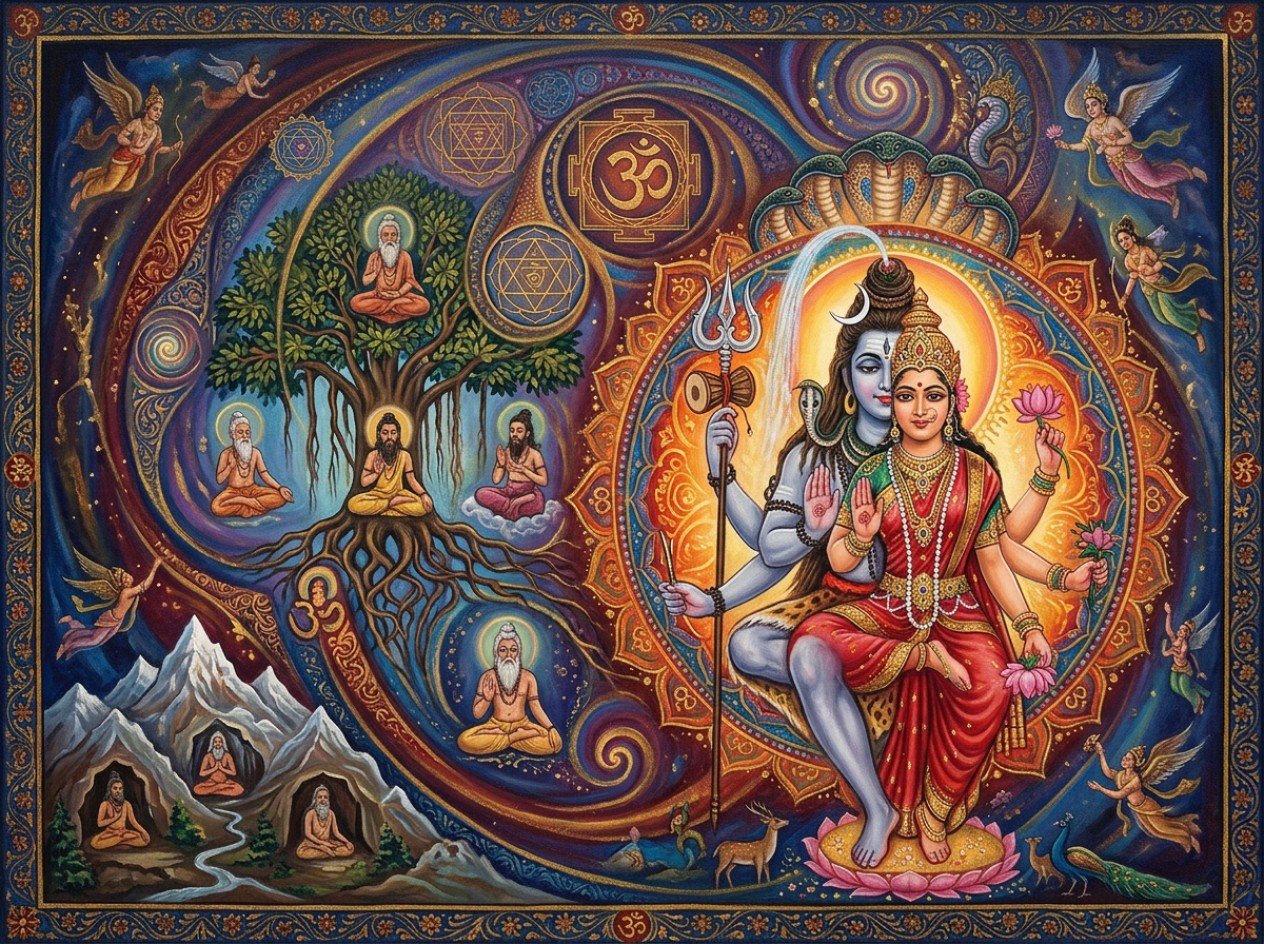
Mystical symbolism also permeates Hindu tradition. The sacred syllable Om is perhaps its most recognisable symbol. Rather than functioning merely as a sound, Om represents the primordial vibration underlying creation itself. Many meditation practices begin or conclude with chanting Om as a way of focusing attention upon the unity of existence. Likewise, the lotus flower symbolises purity emerging from difficult circumstances, while the sacred river Ganges represents both physical and spiritual purification.
The guru, or spiritual teacher, has traditionally played an important role within Hindu mysticism. Genuine teachers are respected not because they possess secret knowledge unavailable elsewhere, but because they have devoted years to disciplined practice and can guide students wisely through their own spiritual development. At the same time, authentic Hindu traditions consistently emphasise humility and ethical conduct, recognising that genuine spiritual authority is demonstrated through compassion, integrity, and service rather than charisma alone.
Modern Hinduism continues evolving while remaining deeply connected to its ancient foundations. Across the world, millions of practitioners continue observing traditional festivals such as Diwali and Holi, practicing meditation and yoga, studying sacred texts, and participating in devotional worship. At the same time, Hindu philosophy has profoundly influenced global discussions concerning mindfulness, consciousness, environmental ethics, and comparative religion. Thinkers such as Swami Vivekananda, Paramahansa Yogananda, and Mahatma Gandhi introduced many aspects of Hindu spirituality to Western audiences during the nineteenth and twentieth centuries, encouraging dialogue between Eastern and Western philosophical traditions.
As someone who has spent many years studying comparative religion, I find Hindu mysticism especially valuable because it consistently encourages both intellectual curiosity and personal transformation. It asks us not only what we believe but how we live. Are we cultivating compassion? Are we becoming less attached to selfish desires? Are we recognising the dignity and interconnectedness of all living beings? These questions remain every bit as relevant in modern America as they were in ancient India.
Hinduism and its mystical traditions remind us that spiritual growth is not measured simply by accumulating religious knowledge but by gradually transforming the character. Wisdom, humility, compassion, self-discipline, gratitude, and loving service become the outward expressions of inward realisation. Whether one approaches Hinduism as a practising believer, a student of comparative religion, or simply someone interested in humanity's spiritual heritage, it offers one of history's richest explorations of consciousness, meaning, and the enduring relationship between the individual soul and the infinite mystery we call the Divine.