


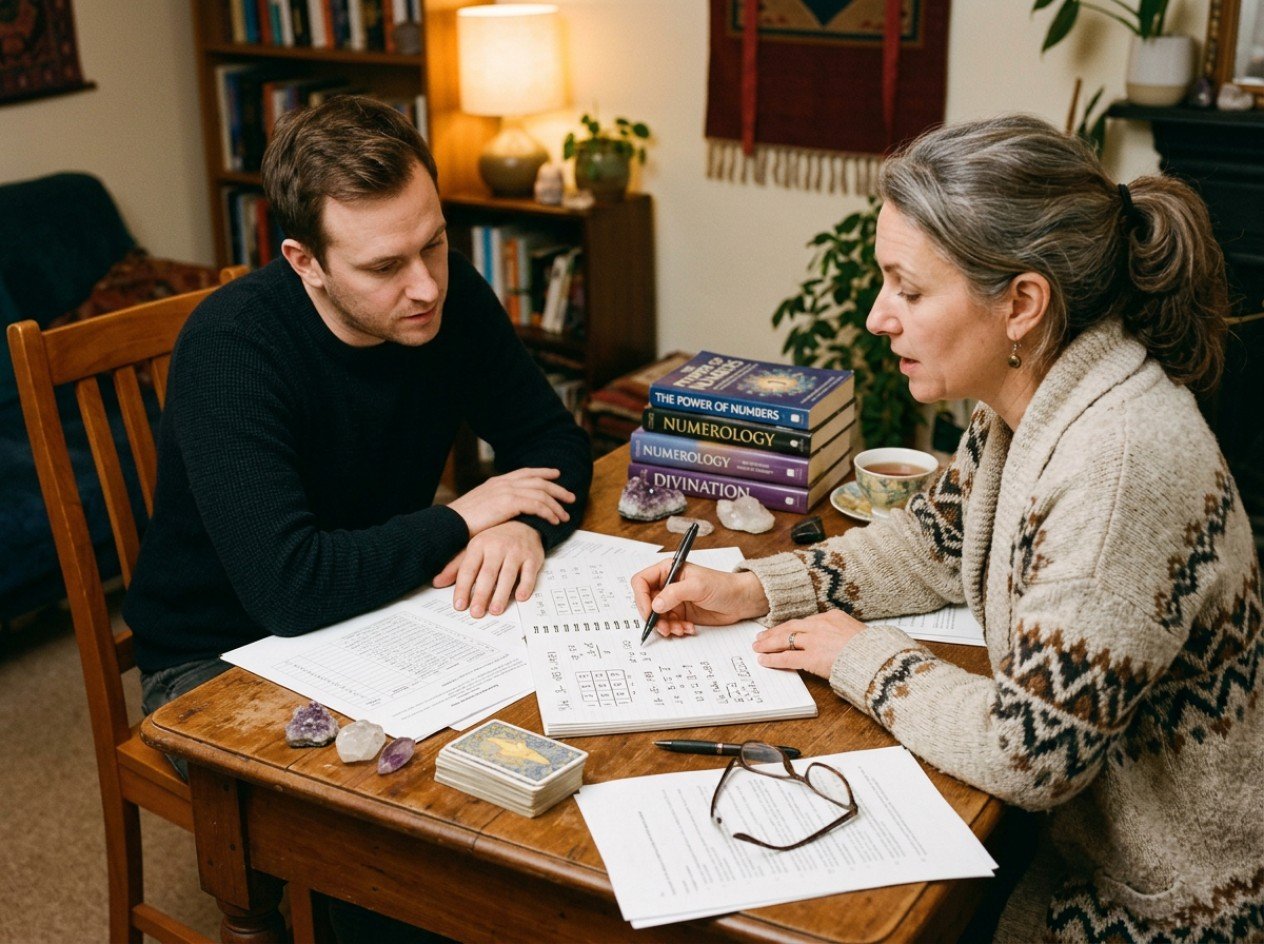
The Meaning of Life Path Numbers
I want to say something which may seem slightly unfashionable for this blog, I came to numerology reluctantly. My academic background, anthropology in the UK, then a doctorate at Zurich before I eventually landed in Boston, left me with the kind of categorical suspicion toward systems that assign meaning to numbers that you'd expect from someone who spent a formative decade arguing about whether mathematical objects actually exist. Numbers, my training insisted, are abstract entities. They do not care about you.
And yet. There is a long tradition, considerably longer than the sceptical tradition I was trained in, that holds the opposite view with remarkable consistency across cultures and centuries. The Pythagoreans, and yes, we mean Pythagoras himself, the same man whose theorem you learned at school, working in southern Italy in the sixth century BCE, believed that numbers were not merely useful abstractions but the actual substance of reality. Numbers, for Pythagoras, were not something we invented to count sheep. They were the architecture of existence. What strikes me now, having spent some years taking this seriously rather than dismissing it, is how much more interesting that position is than it first appears.
Numerology, in its modern Western form, is the descendant of that Pythagorean conviction. The specific practice I want to discuss here, the Life Path number, is among the most accessible and most personally revealing entry points into the system. It requires nothing more than your date of birth and a small amount of arithmetic, and what it produces is not a prediction but something more interesting: a map of the central lesson your particular life appears to be organised around.
The calculation is simple but requires care. You list your birth month, birth day, and birth year as a sum, add them together, and reduce the result to a single digit, with one important exception. Numerology recognises eleven working numbers: the integers one through nine, and two special cases called master numbers, 11 and 22. These are not reduced further. The reason for the specific method of calculation, rather than simply adding all the digits of your birth date in a single row, is precisely to preserve these master numbers if they appear. If you were born on 29 December 2004, adding month (12), day (29), and year (2004) gives you 2045. Add those four digits: 2+0+4+5 = 11. Had you simply added all the digits of the date in sequence, you would have arrived at 2, the master number would have vanished entirely, like a species discovered and immediately classified into extinction.
What does the number mean once you have it? This is where the system becomes genuinely interesting, and where I'd invite even the sceptically inclined to stay with me rather than retreating to the safety of dismissal.
The Life Path is not a description of your personality in the way that, say, a psychological profile might be. It is better understood as a description of what you are here to learn, the particular territory of human experience that your life will repeatedly, sometimes uncomfortably, ask you to engage with. A Life Path 1 is organised around the development of genuine independence and original self-expression; the challenge is finding the courage to stand apart and lead rather than follow. A Life Path 2 asks for the cultivation of cooperation, sensitivity, and the grace of working harmoniously alongside others, qualities that may not come easily to someone temperamentally inclined toward self-sufficiency. A Life Path 3 is centred on creative self-expression; the lesson is learning to share the inner life outwardly, whether through art, writing, conversation, or some other form of genuine expression.
Life Path 4 is the path of discipline, patience, and structural integrity, the lesson of working honestly within limits rather than resisting them. Life Path 5 is the path of freedom, versatility, and the right use of an abundant and restless energy; the challenge is focus, and the reward of achieving it is a rate of progress that astonishes. Life Path 6 carries a lesson in responsibility and care; people on this path often find themselves appointed, as if by some invisible committee, as the person others come to with their problems. Life Path 7 is the path of the inner seeker, drawn toward solitude, deep thinking, and the hidden dimensions of experience, but challenged to connect that inner richness to the world outside.
Life Path 8 is concerned with the relationship between material ambition and genuine power, the lesson is learning to achieve without becoming defined by achievement. Life Path 9 is perhaps the most paradoxical: its central lesson is the satisfaction of giving, of contributing something larger than the self, and yet it is precisely the path on which others are most likely to take advantage of that generosity, making the lesson harder, and more necessary, to truly learn.
Then there are the master numbers. Life Path 11 is the path of the visionary, idealistic, intuitively gifted, and carrying a sensitivity that can be as much burden as gift. The challenge is learning to channel that heightened awareness rather than being overwhelmed by it; the potential, when the path is walked consciously, is a genuinely inspiring presence in the lives of others. Life Path 22, sometimes called the master builder, combines the visionary quality of the 11 with a powerful practical capacity, people on this path can achieve on a scale that is genuinely remarkable, though it usually takes them some time to understand what they are actually supposed to be building.
A question that arises almost immediately when people encounter this system is: what if I dislike my Life Path? What if another number's description sounds more appealing, more comfortable, more like the life I'd have chosen? This is, I think, exactly the right question to sit with, because the answer is illuminating. The Life Path is not describing the life you would prefer, it is describing the life through which your particular constellation of lessons arrives. The comfort of the Three's natural expressiveness, or the enthusiasm of the Five, is not necessarily available to the Seven, precisely because the Seven's work is in a different direction. But here is the thing that took me some time to appreciate: the path that seems harder is not less valuable. It is simply more specifically yours.
What I find philosophically interesting about the Life Path system, and what has shifted my position from polite scepticism toward something more like genuine respect, is not the claim that it is literally true in some strong metaphysical sense. It is the pattern of usefulness. When I have worked through the calculation with people, the number that emerges has a consistent tendency to name something real about the shape of that person's life, not their surface characteristics, but the deeper tensions and directions that a thoughtful, honest conversation eventually arrives at anyway. Whether that is because the system is tracking something genuine about the relationship between number and existence, or because the categories are subtle enough and broad enough to organise experience in genuinely illuminating ways, is a question I have learned to hold open rather than close prematurely.
Pythagoras, I suspect, would find both possibilities both amusing and interesting. If you are interested in "calculating" your life path number, you can do so using our calculator, which can be accessed by clicking here.