


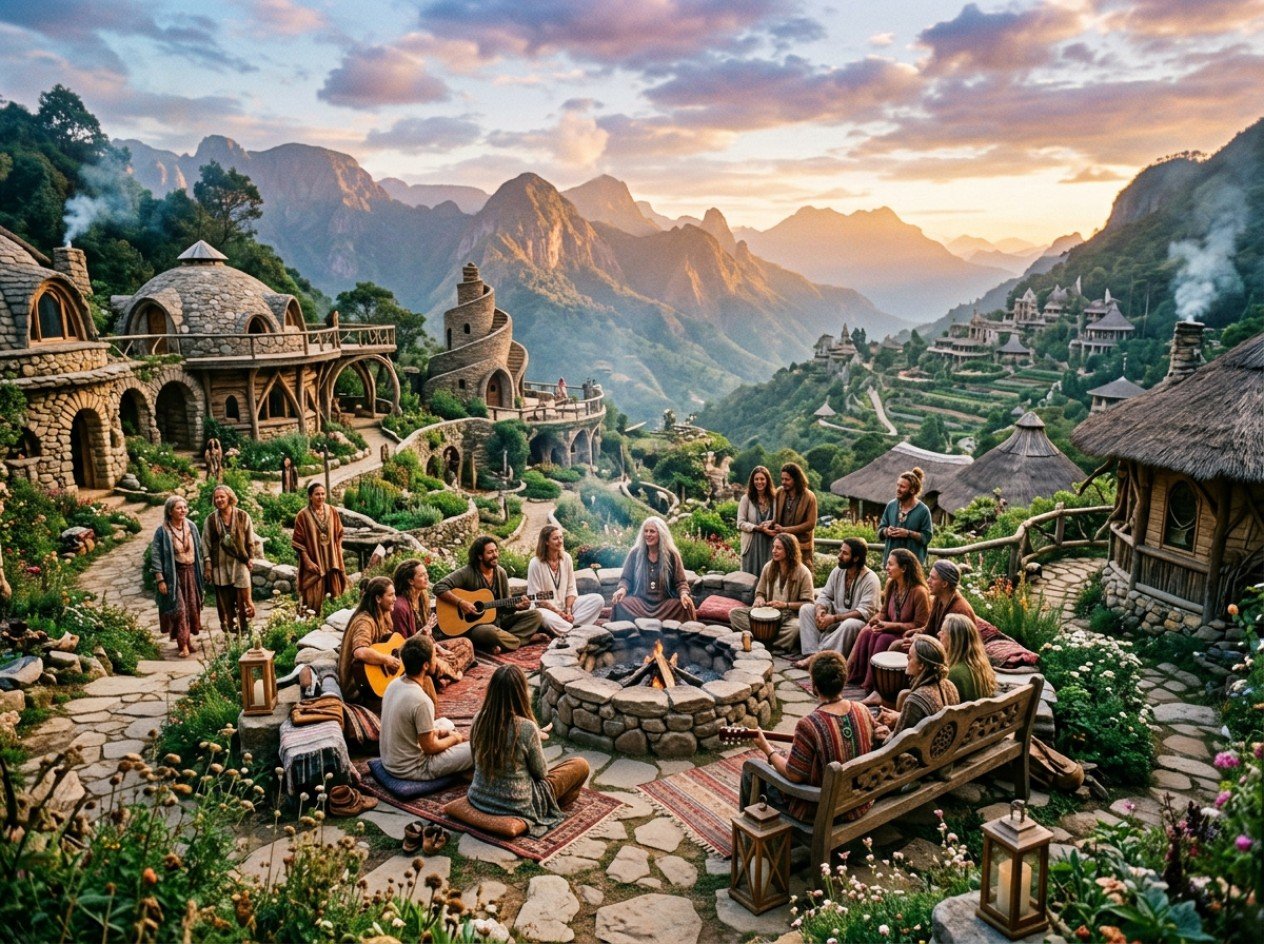
The Kingdom of Agartha
One of the things I have always appreciated about New Age spirituality is its willingness to ask imaginative questions. It doesn't always seek definitive answers as much as it encourages exploration. During my travels through Thailand, Cambodia, Indonesia, Myanmar, and Nepal, I met monks, mystics, artists, and travellers who all seemed to share a similar curiosity about the unseen dimensions of life. Although their traditions differed enormously, they often spoke about hidden wisdom, sacred places, enlightened beings, and humanity's untapped spiritual potential. When I later encountered stories about the legendary Kingdom of Agartha, I was reminded of many of those conversations. Whether regarded as literal history, symbolic mythology, or modern spiritual folklore, Agartha occupies a fascinating place within New Age thinking because it represents humanity's enduring hope that somewhere beyond ordinary experience lies a deeper source of wisdom.
Before exploring Agartha itself, it is worth understanding the broader context of New Age spirituality. Unlike traditional religions built around established doctrines, New Age thinking developed gradually during the twentieth century by drawing inspiration from a wide variety of philosophical and spiritual traditions. It incorporates ideas from Eastern religions, Western esotericism, meditation, astrology, Indigenous spirituality, psychology, alternative healing, comparative mythology, and modern metaphysical thought. Rather than presenting a single belief system, it encourages individuals to create personal spiritual paths based upon practices and ideas that resonate with their own experience.
One recurring theme throughout New Age philosophy is the belief that humanity is still evolving spiritually. According to this perspective, human consciousness has not reached its highest potential. Through meditation, self-awareness, compassion, creativity, and personal transformation, individuals may gradually awaken to deeper levels of understanding. It is within this wider framework that legends such as Agartha become meaningful. They symbolise not only hidden places but hidden possibilities within ourselves.
The story of Agartha
The story of Agartha, or sometimes Agharta, Agarttha, or Agartha, describes a vast underground kingdom inhabited by spiritually advanced beings who possess extraordinary wisdom, harmony, and technological knowledge. The exact details vary considerably depending upon the source. Some accounts describe magnificent cities illuminated without sunlight. Others speak of enlightened masters guiding humanity from behind the scenes, while still others connect Agartha with ancient civilizations such as Atlantis or Lemuria.
It is important to recognise that there is no archaeological or historical evidence demonstrating that Agartha exists as a literal underground civilization. Historians generally trace the modern legend to nineteenth-century European esoteric literature rather than to ancient historical documents. Nevertheless, the story has become deeply embedded within certain strands of modern mystical and New Age thought because of what it symbolically represents rather than because of historical verification.
Argatha & Alexandre Saint-Yves d'Alveydre
One of the earliest writers associated with the development of the Agartha legend was the French occultist Alexandre Saint-Yves d'Alveydre during the late nineteenth century. He described an enlightened subterranean civilisation governed by spiritually evolved leaders who preserved ancient knowledge while remaining hidden from the conflicts of the surface world. His writings influenced later esoteric thinkers, who expanded the mythology considerably during the early twentieth century.
Another important figure was Ferdinand Ossendowski, whose 1922 book Beasts, Men and Gods described stories he claimed to have heard while travelling through Mongolia concerning a mysterious underground kingdom ruled by the "King of the World." Although historians continue debating the origins and accuracy of these accounts, the book captured the imagination of many readers interested in Eastern mysticism and hidden civilizations.
Over time, New Age writers blended these European esoteric traditions with ideas drawn from Tibetan Buddhism, Hindu philosophy, Theosophy, and various legends concerning hidden Himalayan kingdoms. In doing so, Agartha gradually evolved into a symbol of humanity's forgotten spiritual heritage.
People sometimes confuse Agartha with Shambhala, yet the two traditions have quite different origins. Shambhala appears within Tibetan Buddhist literature as a hidden kingdom associated with enlightened rulers and future spiritual renewal. Agartha, by contrast, emerged primarily within Western esoteric literature, although later writers frequently connected the two. During my own travels through Nepal and northern Thailand, I occasionally encountered references to Shambhala in Buddhist contexts, but I never encountered traditional Buddhist teachers presenting Agartha as part of established Buddhist doctrine. This distinction is worth remembering because New Age spirituality often combines ideas originating from different cultural traditions.
Argatha From A Symbolic Perspective
From a symbolic perspective, however, Agartha becomes especially interesting. Psychologically speaking, the underground kingdom may represent the unconscious mind itself. Carl Jung frequently observed that myths involving caves, hidden cities, underground chambers, and mysterious journeys often symbolise the exploration of deeper layers of consciousness. Descending beneath the Earth's surface can represent descending beneath ordinary awareness in search of wisdom, healing, or self-knowledge.
This interpretation helps explain why the legend continues appealing to modern spiritual seekers. Rather than focusing upon geography, it becomes a story about inner development. The "hidden kingdom" exists not necessarily beneath mountains but beneath habitual patterns of thinking. Meditation, contemplation, creativity, and personal reflection become symbolic journeys into one's own inner Agartha.
Many New Age practitioners also associate Agartha with the idea of ascended masters. According to various esoteric traditions, highly evolved spiritual beings continue assisting humanity's development without seeking public recognition. These figures are sometimes described as guardians of ancient wisdom who intervene subtly during periods of significant global change. Once again, these beliefs occupy the realm of spiritual and metaphysical tradition rather than established historical fact, but they remain influential within many contemporary mystical communities.
One fascinating aspect of New Age thought is its tendency to reinterpret myths as metaphors for personal transformation. Whether discussing Atlantis, Lemuria, Shambhala, or Agartha, many modern writers encourage readers to focus less upon proving literal existence and more upon asking what these stories reveal about human potential. In this sense, Agartha symbolises qualities we hope to cultivate ourselves: wisdom, peace, cooperation, compassion, balance, and harmony with nature.
The idea of hidden wisdom also resonates strongly with many Asian spiritual traditions I encountered while travelling. In Buddhist monasteries throughout Southeast Asia, teachers often reminded students that genuine insight cannot simply be given by another person. It must gradually emerge through disciplined practice, ethical living, and direct experience. While these traditions do not teach Agartha in the Western esoteric sense, they share the broader conviction that profound wisdom often remains hidden—not because someone deliberately conceals it, but because it requires inner transformation to recognise it.
Meditation occupies an especially important place within New Age approaches to Agartha. Some practitioners visualise journeys into symbolic underground temples during guided meditations, while others regard the kingdom as representing higher states of consciousness accessed through contemplative practice. Whether understood literally or metaphorically, meditation becomes the means by which individuals seek greater connection with wisdom, intuition, and spiritual insight.
Critics of New Age Interpretations
Critics of New Age interpretations rightly caution against blending unrelated religious traditions without recognising their historical contexts. Hinduism, Buddhism, Indigenous traditions, Theosophy, Hermeticism, and Western occultism each possess distinct histories and philosophical foundations. Responsible scholarship acknowledges these differences while still appreciating the creative ways in which modern spirituality has drawn inspiration from multiple sources.
At the same time, I think it would be a mistake to dismiss myths like Agartha simply because they cannot be verified archaeologically. Human beings have always told stories expressing hopes, fears, ideals, and aspirations. Whether we read Plato's Atlantis, medieval accounts of the Holy Grail, or Indigenous stories about sacred mountains, myths often reveal more about human values than about historical geography. Agartha belongs within that rich tradition of symbolic storytelling.
One reason these legends continue flourishing is that they offer an alternative vision of civilisation itself. Rather than societies driven by competition, conflict, and material success, Agartha describes communities governed by wisdom, cooperation, knowledge, and spiritual maturity. In an age marked by environmental concerns, political division, and rapid technological change, it is perhaps unsurprising that many people find such imagery emotionally compelling. It expresses not merely nostalgia for a lost civilisation but hope for a wiser future.
As someone who has spent many years travelling as well as studying comparative spirituality, I have learned that every culture possesses stories about hidden places of wisdom. Sometimes they are mountains, islands, forests, monasteries, or celestial realms. Their physical location matters less than the qualities they represent. They remind us that the search for wisdom often begins by looking inward rather than outward.
Ultimately, I think Agartha remains valuable precisely because it invites reflection rather than certainty. Whether viewed as esoteric legend, symbolic mythology, psychological metaphor, or spiritual possibility, it encourages us to ask meaningful questions. What kind of civilisation are we creating? What qualities define genuine wisdom? How might compassion become stronger than fear? Could the hidden kingdom we seek ultimately represent the untapped potential within every human heart? For me, that has always been the most interesting interpretation. After years of travelling across Southeast Asia and returning home to the Pacific Coast, I've come to believe that the world's greatest spiritual journeys rarely lead to secret underground cities. Instead, they gradually lead us toward greater kindness, deeper self-awareness, and a growing appreciation that wisdom is less about discovering extraordinary places than about learning to see ordinary life with extraordinary clarity. In that sense, Agartha continues to inspire not because it has been found on any map, but because it reminds us that the deepest treasures may still be waiting to be uncovered within ourselves.