
The New Age Views on Gender & Sexuality
I've been sitting with this topic for a while, the way I sit with most things that feel important, a little cross-legged on my back porch with tea going cold beside me and the the morning fog still sitting over the bay. Gender and sexuality. The New Age has things to say about both of these that I think are worth saying out loud, clearly, without the kind of hedging that makes spiritual writing feel safe but useless.
Here's where I want to start: virtually every mystical and metaphysical tradition that feeds into what we broadly call New Age thinking agrees on one foundational point. The soul has no gender. Whatever you believe about the soul, whether it's a spark of divine light, an aspect of universal consciousness, a being that moves through multiple incarnations, it is not male or female in any fixed or permanent sense. Madame Blavatsky's Theosophical framework made this explicit in the nineteenth century: souls cycle through many lifetimes in bodies of different sexes, accumulating experience from all of them. The same view appears in Eastern teachings that entered Western consciousness through the counterculture of the sixties and seventies, the soil in which a lot of New Age thinking took root. The Atman, the deeper self of Vedantic philosophy, is described as beyond all attributes, including the attribute of gender. Consciousness, at its most fundamental level, simply is. It doesn't have a pronoun.
What this means practically, once you really absorb it, is significant. If the soul has no fixed gender, then rigid cultural insistence on a single, lifelong, immutable gender identity starts to look less like natural law and more like a particular historical arrangement. The New Age perspective, and I'm aware this is not a monolith, that there are as many New Age views as there are people who hold them, but I'm talking about the broad current, tends to understand gender as fluid, experiential, and ultimately secondary to the deeper truth of the self. Not that gender is meaningless. But that it is not the deepest thing.
The Divine Feminine and the Divine Masculine are concepts that run through a great deal of New Age spirituality, and I want to spend a moment with these because they can be misread. When writers and teachers in this tradition talk about balancing the feminine and masculine energies within ourselves, they are not describing a binary that maps onto biological sex. They're describing two currents of universal energy, receptive and expressive, lunar and solar, being and doing, that exist in every person regardless of the body they inhabit. The healing that so much New Age practice aims at is partly the healing of this internal split: the reclamation of the nurturing, intuitive, receptive dimension of experience in a culture that has systematically devalued it, regardless of who is doing the reclaiming. A man doing this work is not becoming feminine in any diminishing sense. He is becoming whole.
This framework has made New Age communities, at their best, genuinely welcoming spaces for people whose gender or sexual identity doesn't fit neatly into conventional categories. If the soul is beyond gender, if we are all working toward an integration of polarities within ourselves, then the person who lives outside binary categories isn't a category error, they might actually be somebody who is living closer to a deeper truth than the rest of us are managing. I've met people in spiritual communities on this coast who describe their gender fluidity or their nonbinary identity in exactly these terms: not as a problem requiring explanation, but as an expression of something the soul naturally tends toward when it isn't being compressed by social convention.
Sexuality, in New Age thinking, is similarly approached as something sacred rather than suspect. This is a genuine departure from the dominant religious frameworks of Western history, most of which have treated sexuality as at best a necessary inconvenience and at worst a source of spiritual danger. The New Age draws instead on Tantra, often in simplified or adapted Western forms, it should be said, and scholars of classical Tantra will correctly point out the distances involved, but the core insight that makes Tantra relevant here is that the body and its energies are not obstacles to spiritual development but potential vehicles for it. Sexual energy, understood as a form of life force or prana or kundalini, is not antithetical to spiritual development. It is one of the most powerful energies available to us.
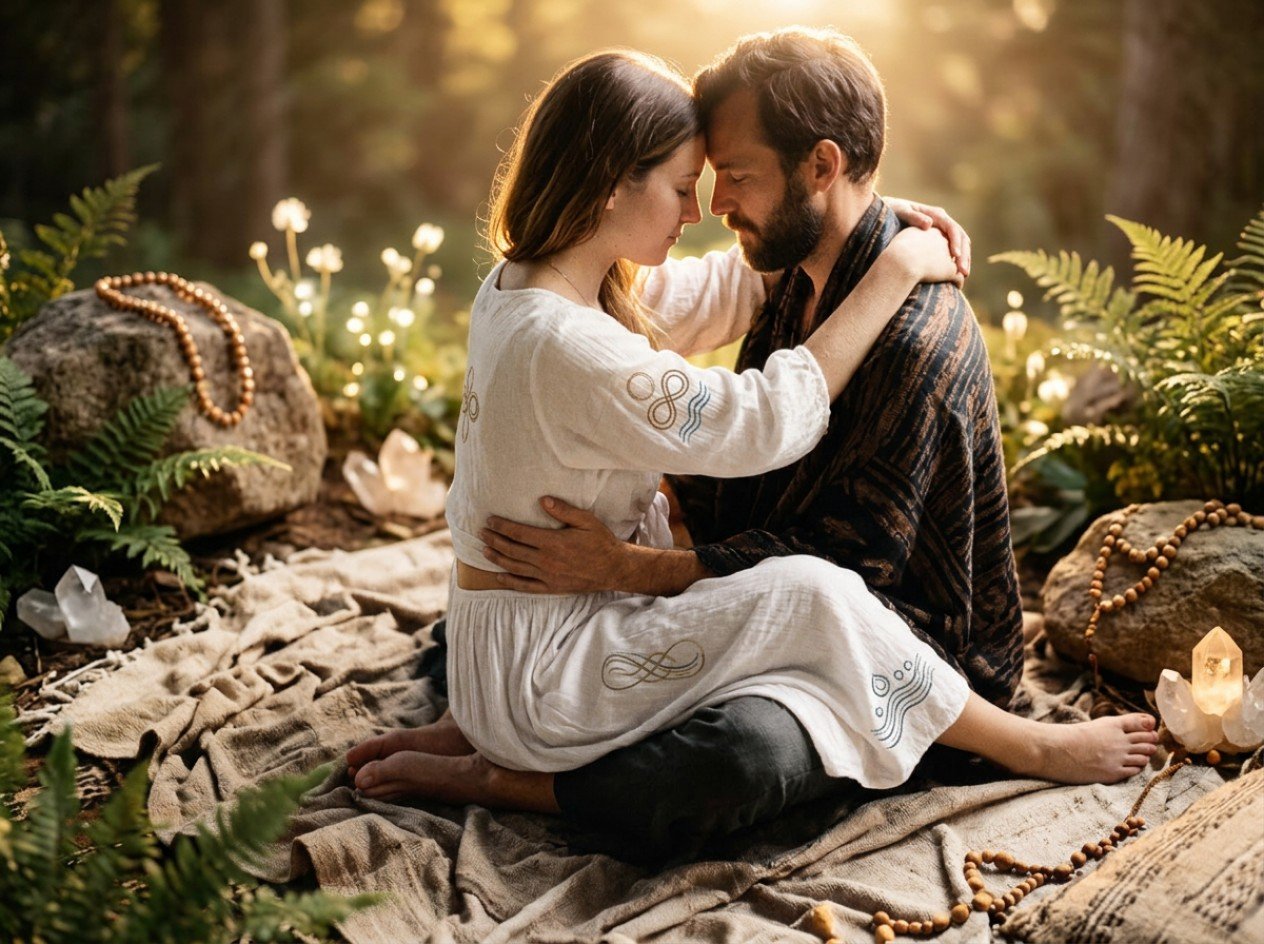
What follows from this is a view of sexual expression that is affirmative rather than restrictive, and that places consent, awareness, and genuine connection at the centre rather than rules about which configurations of people and bodies are permitted. New Age sexuality, when it's thoughtful, is about bringing consciousness to the experience, about recognising another person as a being of light before anything else, about the quality of attention and presence you bring, about what opens rather than what is permitted or forbidden. From this framework, the question of whether a relationship is between people of the same sex or different sexes, or whether individuals involved are gender-conforming or not, is genuinely secondary to the quality of the consciousness and the care involved.
The Aquarian Age narrative, the astrological framework through which many New Age thinkers understand this historical moment, has always had an egalitarian and communitarian quality. The Age of Aquarius is understood as a time of breaking down old hierarchies and rigid structures, of moving toward collective liberation and the recognition of each individual's inherent spiritual worth. In this context, the emergence of greater visibility and social recognition for LGBTQ+ people is often understood within New Age communities not as a social or political development but as a spiritual one: a sign that the old restrictive structures are genuinely loosening, that the Aquarian current is doing what it was always going to do.
I want to be honest about something, though, because I think honesty is more useful than a tidy narrative. New Age communities have not always lived up to these ideals. There have been tendencies in some areas of New Age thinking, certain readings of the Divine Feminine and Masculine, some forms of goddess spirituality, that have inadvertently reinforced a biological essentialism that actually constrains transgender and nonbinary people rather than liberating them. Saying that women are naturally more intuitive and men more rational, even when dressed in spiritual language, is not a liberating move. The most coherent version of New Age thinking on gender, the version that actually follows from the premises about the soul and about consciousness, leads away from that kind of essentialism rather than toward it.
What it leads toward, when it follows its own logic honestly, is something genuinely beautiful: a vision of human beings as spiritual entities in temporary, varied, and ultimately provisional physical forms, each of us working out our particular path in the particular configuration this lifetime gave us, none of those configurations ranking higher than another in the sight of whatever we choose to call the divine. The fog has burned off the bay now. My tea is completely cold. I think that's probably the most useful thing I've tried to say is that whatever form you come in or adopt, you are not a lesser expression of the divine. You are the divine, expressing itself in the only way it knows how to right now. Which is exactly you.