


Meditation & Mysticism
When I was in my twenties, long before I settled on the West Coast, I spent several years travelling through North Africa, Turkey, and parts of the Middle East. During that time, I had the privilege of sitting with Islamic scholars, teachers, and students who generously shared not only their knowledge but also their hospitality. What struck me most was how often Western discussions of Islam overlooked its rich contemplative tradition. Many people think of Islam primarily in terms of law, theology, or history, yet beneath these important foundations lies a deeply reflective spiritual heritage that has inspired mystics, poets, philosophers, and ordinary believers for well over a thousand years. Meditation, although not always described by that English word, occupies an important place within Islamic spirituality. Rather than seeking escape from the world, Islamic meditation encourages greater awareness of God, deeper self-understanding, and a life shaped by compassion, humility, and remembrance.
One important point deserves emphasis from the beginning. The word "meditation" can mean different things in different traditions. Within Buddhism it often refers to practices cultivating mindfulness or insight. In Hindu traditions it may involve concentration upon sacred sounds or divine realities. Within Islam, meditation generally centres upon remembering God, contemplating creation, examining one's own heart, and developing greater spiritual awareness. The Arabic language contains several words that express different aspects of these contemplative practices, each carrying its own nuance and emphasis.
Islamic Meditation & Dhikr (Rememberance)
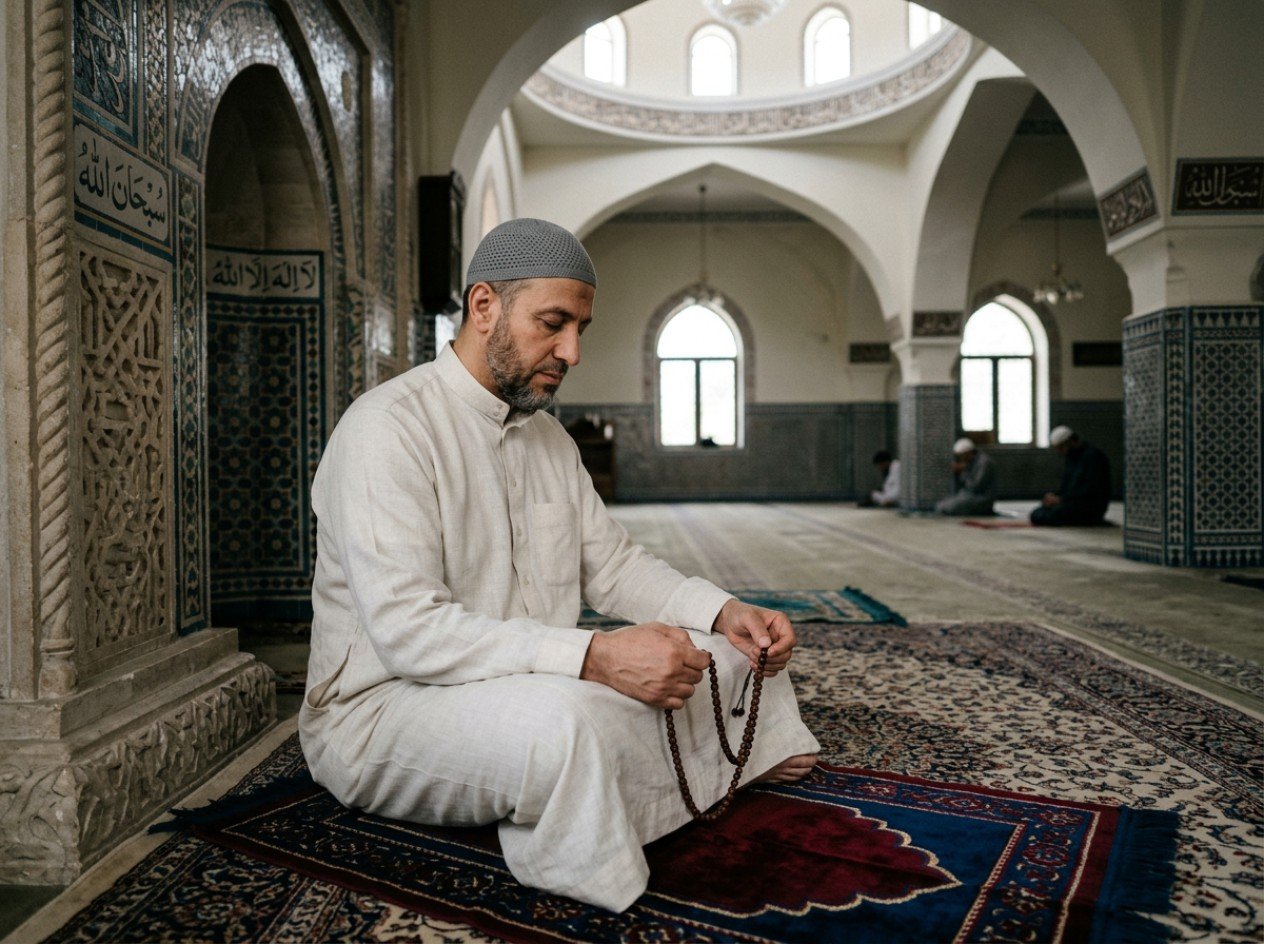
Perhaps the most fundamental of these is Dhikr (ذِكْر), meaning "remembrance." Dhikr refers to the continual remembrance of God through spoken phrases, silent reflection, prayer, or inward awareness. The Qur'an repeatedly encourages believers to remember God frequently, not merely during formal worship but throughout daily life. This remembrance is not intended as mechanical repetition alone. Rather, it seeks to awaken the heart, gradually aligning one's thoughts, intentions, and actions with an awareness of the Divine.
Many forms of Dhikr involve quietly repeating one of the beautiful names or attributes of God. Islam traditionally recognises the Ninety-Nine Beautiful Names, each expressing a different aspect of God's nature. Among them are Ar-Rahman (The Most Compassionate), Ar-Rahim (The Most Merciful), Al-Hakim (The All-Wise), and As-Salam (The Source of Peace). Repeating these names slowly and attentively is not regarded as magical incantation but as a means of allowing their qualities to shape the believer's own character. If one continually reflects upon divine mercy, for example, one naturally becomes more attentive to practising mercy toward others.
Another important concept is Tafakkur (تَفَكُّر), meaning contemplation or thoughtful reflection. Tafakkur encourages believers to observe the natural world carefully, recognising signs of divine wisdom throughout creation. The Qur'an repeatedly invites people to reflect upon the stars, mountains, rivers, plants, animals, changing seasons, and even the human body itself. Nature becomes a source of spiritual education rather than simply a physical environment. This approach reminds me of countless evenings spent sitting beneath desert skies with scholars who would quietly point toward the stars while discussing verses from the Qur'an. Their lessons always seemed to begin with careful observation before moving toward deeper theological reflection.
Closely related is Tadabbur (تَدَبُّر), a word describing deep contemplation of the Qur'an itself. Rather than reading scripture hurriedly, Tadabbur encourages careful, reflective engagement with its meanings. Readers pause, consider, question, and allow particular passages to resonate within their lives. The goal is not merely intellectual understanding but personal transformation. Scripture becomes something to inhabit rather than simply study.
Islamic Meditation & Sufism
Among the Islamic traditions most closely associated with contemplative spirituality is Sufism, often described as the mystical dimension of Islam. It is important to recognise that Sufism is not a separate religion. Rather, it represents one approach to living the Islamic faith, placing particular emphasis upon inner purification, love of God, humility, and spiritual discipline. Although Sufi practices vary considerably between different orders, meditation, remembrance, poetry, music in some traditions, and service to others frequently occupy central roles.
One of the greatest Sufi teachers, Jalal al-Din Rumi, wrote extensively about the journey from the ego toward divine love. His poetry continues inspiring readers around the world because it speaks simultaneously to intellect and emotion. Yet Rumi's work should not be separated from its Islamic foundation. His mystical vision emerged directly from prayer, Qur'anic study, disciplined spiritual practice, and profound devotion to God. Too often, contemporary readers appreciate the beauty of his poetry while overlooking the religious context from which it arose.
Islamic meditation frequently begins with stillness. Before prayer, Muslims perform Wudu (وُضُوء), the ritual washing of the hands, face, arms, and feet. Although primarily an act of ritual purification, Wudu also serves a psychological purpose. It marks a transition from ordinary activity toward focused spiritual attention. Many contemplative traditions recognise the importance of such transitional rituals because they help prepare the mind for deeper awareness.
Islamic Meditation & The Five Daily Prayers (Salah)
The five daily prayers, or Salah (صَلَاة), also possess deeply meditative qualities. While prayer certainly includes spoken recitation and physical movement, it also encourages concentration, humility, gratitude, and surrender before God. The rhythmic sequence of standing, bowing, prostrating, and sitting creates a physical expression of spiritual devotion. Practised attentively, Salah becomes much more than obligation. It becomes a repeated opportunity to pause amid daily responsibilities and remember what ultimately matters.
One concept that repeatedly appeared during my conversations with scholars was Khushu' (خُشُوع), often translated as humility, reverence, or inward attentiveness during worship. Khushu' describes a quality of presence rather than a particular technique. The goal is not simply completing prayer correctly but praying with the whole heart. Many teachers explained that distractions naturally arise, yet spiritual maturity consists in gently returning one's attention to God without frustration or self-criticism.
Another important practice involves Muhasabah (مُحَاسَبَة), meaning self-examination or self-accounting. Before going to sleep, many spiritual teachers recommend reviewing the day honestly. Where did I act with kindness? Where did impatience overcome me? Did I speak truthfully? Was I grateful? Muhasabah resembles practices found in several religious traditions, reminding us that spiritual growth requires honest reflection rather than constant self-justification.Silence also occupies an understated but important place within Islamic spirituality. Although Islam places great value upon recitation, discussion, and communal worship, many scholars emphasise the importance of quiet contemplation. Constant speech easily distracts us from noticing our own motivations. Silence allows thoughts to settle, making deeper awareness possible. During my travels, I came to appreciate how comfortable many teachers were with pauses in conversation. They seemed to understand that wisdom often emerges between words rather than through endless explanation.
Breathing itself occasionally becomes part of contemplative practice, particularly within certain Sufi traditions. While approaches vary, some practitioners coordinate gentle breathing with silent remembrance of God. The breath becomes a reminder that life itself is a continual gift. Each inhalation symbolises receiving, while each exhalation reflects gratitude and surrender. These practices remain grounded in remembrance rather than becoming ends in themselves.
Islamic meditation also possesses a profoundly ethical dimension. Unlike approaches focused exclusively upon personal tranquillity, Islamic spirituality consistently connects contemplation with moral action. Remembering God should gradually produce greater honesty, generosity, patience, justice, and compassion. A person who meditates beautifully yet treats neighbours poorly has missed the point entirely. Spiritual awareness expresses itself through character as much as through inward experience. The Qur'an's repeated encouragement to care for the poor, protect the vulnerable, honour parents, fulfil promises, and forgive others illustrates this integration. Meditation is never isolated from daily life. Rather, it prepares the heart to live more faithfully within the ordinary responsibilities of family, work, and community. The inner and outer dimensions of life continually support one another.
It is also worth noting that Islamic meditation does not seek the dissolution of personal identity in quite the same way as some Eastern traditions. While mystical language sometimes speaks poetically of nearness to God, classical Islamic theology maintains a distinction between Creator and creation. The believer seeks closeness, love, obedience, and remembrance while recognising God's transcendence. This theological framework gives Islamic contemplation its distinctive character.
Modern scientific research has increasingly demonstrated that contemplative practices involving focused attention, gratitude, reflection, and regulated breathing may contribute to reduced stress, improved emotional regulation, and enhanced wellbeing. These findings do not prove theological claims, nor were traditional Islamic practices developed for medical purposes. Nevertheless, they suggest that disciplines cultivated primarily for spiritual reasons may also support psychological health.
One lesson I carried home from those years of study was that genuine contemplation rarely depends upon extraordinary experiences. The scholars who most influenced me were neither dramatic nor mystical in the popular sense. They possessed remarkable patience, kindness, humility, and generosity. Their meditation was visible less in unusual visions than in the quiet consistency of their character. They reminded me repeatedly that the purpose of remembrance is not to become fascinated with spirituality itself but to become more faithful, more compassionate, and more aware of God's presence in every aspect of life. Islamic meditation invites believers into a continual relationship of remembrance. Through Dhikr, Tafakkur, Tadabbur, Salah, Muhasabah, and countless quiet moments of reflection, the heart gradually learns to remain attentive even amid the ordinary demands of daily life. For me, those years spent learning from Islamic scholars transformed not only my understanding of Islam but also my appreciation for contemplation itself. They demonstrated that true meditation is not an escape from reality but a way of encountering it more fully—with gratitude, humility, reverence, and an ever-deepening awareness of the sacred that quietly surrounds us each day.