


Jewish Mysticism & Hitbodedut Meditation
I teach meditation across a lot of traditions, I have certificates in mindfulness-based stress reduction, I trained for three years with a Tibetan Buddhist teacher in Santa Cruz, and I spent a semester sitting with a Zen community in the hills above Berkeley that remains one of the most formative experiences of my adult life. So when I encountered Hitbodedut, the Jewish contemplative practice of spontaneous spoken prayer and radical self-disclosure before the divine, I thought I knew what I was dealing with. I thought it would fit neatly into the taxonomy I had spent twenty years building. It did not. And that refusal to fit neatly is, I have come to understand, one of the most important things about it.
The Meaning of Hitbodedut
The word Hitbodedut comes from the Hebrew root badad, meaning alone or separate. It is sometimes translated as seclusion, sometimes as self-isolation, sometimes as contemplative aloneness. But the translation that feels most alive to me, the one that captures what actually happens when you practice it, is radical solitude, the practice of placing yourself, alone, in the presence of the divine and speaking out loud whatever is true for you in that moment. Not the polished, liturgically appropriate version of what is true. The actual thing. The fear, the confusion, the gratitude, the anger, the longing, the thing you have been carrying that you have not been able to say to anyone else, spoken directly to the source of all being as if it is listening, because the tradition insists that it is.
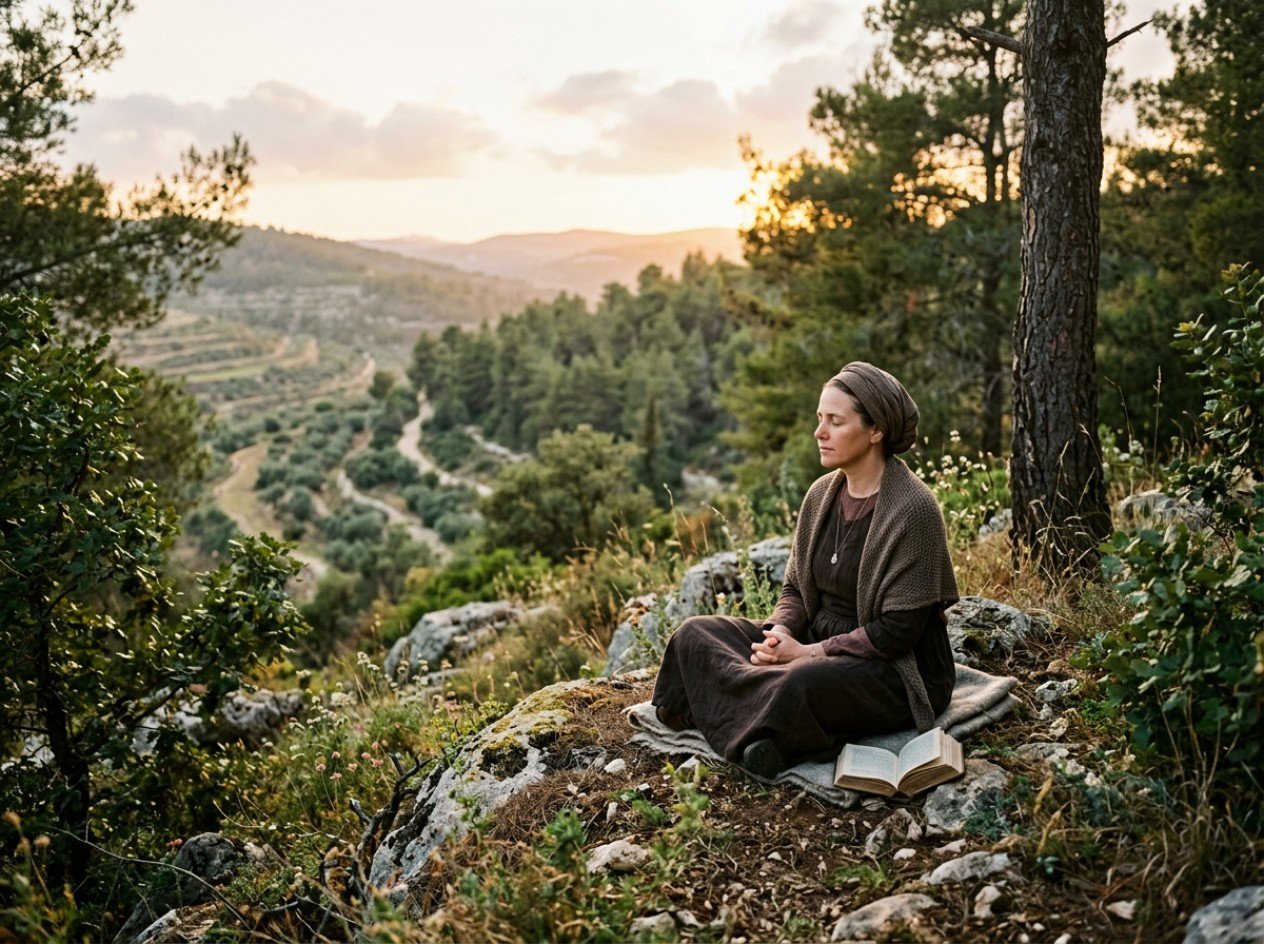
The historical roots of Hitbodedut run deep into Jewish tradition. The great medieval Kabbalist Rabbi Abraham Abulafia, writing in thirteenth-century Spain, developed elaborate techniques of contemplative aloneness involving Hebrew letter combinations and breathing practices as a path to prophetic states. But the figure most responsible for the way most people encounter Hitbodedut today is Rabbi Nachman of Breslov, the Hasidic master who lived in Ukraine from 1772 to 1810 and whose teachings have experienced an extraordinary revival in contemporary Jewish spirituality. Nachman taught that every person should spend at least one hour each day alone with God, ideally in a natural setting, ideally at night, speaking in their mother tongue, in ordinary everyday language, about whatever is most real and most pressing in their inner life.
Nachman's insistence on the mother tongue was not a minor detail. It was a revolutionary move in the context of Jewish religious practice, where formal prayer was conducted in Hebrew, a sacred language that many ordinary Jews, particularly women and the less educated, could recite but not fully understand. By saying that the most valuable prayer was the one you spoke in the language you actually think in, Nachman democratised the contemplative life in a way that has not stopped reverberating. You do not need to be a scholar. You do not need to know the liturgy. You need to be honest and you need to show up. That is all.
The Goal of Hitbodedut
The goal of Hitbodedut is not, in the first instance, the achievement of any particular altered state or spiritual experience, which is one of the ways it differs from many of the meditation traditions I work with. There is no technique to master in the sense of a breath pattern or a visualisation or a mantra that, once correctly executed, produces a reliable result. What Hitbodedut is aiming at is something more relational e.g., the development of an actual, ongoing, honest relationship with the divine, conducted through the medium of honest speech. Rabbi Nachman uses the image of a friend, the kind of friend you can say anything to, with whom you do not have to perform or curate or maintain any particular version of yourself. Hitbodedut is the practice of treating God as that friend, and trusting that the relationship can bear the weight of your actual reality rather than just the presentable version of it.
The contemporary revival of Hitbodedut as a practice owes a great deal to Rabbi Aryeh Kaplan, the American Orthodox rabbi and physicist who died in 1983 at the age of forty-eight and whose extraordinary series of books on Jewish meditation introduced the contemplative tradition to an English-speaking audience that had largely forgotten it existed. Kaplan's Jewish Meditation, published posthumously in 1985, remains one of the most accessible and most rigorous introductions available. He placed Hitbodedut in the context of a broader Jewish contemplative tradition that included mantra-like repetition of divine names, breath awareness practices, and the visualisation techniques of the Kabbalistic tradition, demonstrating that the Jewish textual tradition contained a rich and sophisticated contemplative heritage that had been largely invisible to Western practitioners who assumed meditation was an Eastern import.
Introducing Hitbodedut Meditation
In my teaching practice, I introduce Hitbodedut gradually and usually after people have some experience with more formally structured meditation. The formlessness of it, the absence of technique in the conventional sense, can be disorienting for practitioners who have been trained to believe that meditation is about quieting the mind. Hitbodedut does not quiet the mind. It asks the mind to speak, to speak honestly, out loud, in whatever condition it is in. I often describe it to groups as the inverse of conventional silent meditation: instead of witnessing your thoughts without engaging them, you are giving your thoughts, feelings, and inner life full voice in the direction of the divine presence. The paradox is that this full-voiced, sometimes chaotic, sometimes tearful, sometimes angry conversation often produces a quality of stillness and clarity that years of silent sitting practice has not generated. Not because the technique is superior, but because something about the specific act of honest speech in a relational context, the sense of actually being heard rather than simply observing your own inner weather, touches something that other practices approach differently.
The setting matters, though it is not required. Nachman specifically recommended practicing Hitbodedut outdoors, alone, preferably at night and in a natural environment, a field, a forest, a hillside. Living where I live, on the coast of California, I have access to the kind of landscape that makes this instruction feel less like a historical curiosity and more like the obvious truth it is. Something happens when you stand at the edge of the ocean in the dark and speak honestly to whatever is listening. The scale of the natural world does something to the ego's tendency toward performance and self-protection. You stop worrying about how you sound. You stop editing. And that is precisely when Hitbodedut becomes what it is supposed to be.
What I love most about teaching this practice is watching people discover that they already know how to do it. The mechanics of Hitbodedut, going somewhere alone, speaking honestly about what is real, are not techniques in need of acquisition. They are natural human capacities in need of permission. The tradition's contribution is the theological framework that makes the practice meaningful: the insistence that there is someone listening, that the listening is complete and without judgment, and that the most authentic prayer is always the one that tells the truth. That framework may or may not be one a given practitioner can fully embrace. But in my experience, even practitioners who hold it lightly, as a possibility rather than a certainty, find that the practice opens something. The combination of solitude, honest speech, and whatever mystery receives it has been working for a very long time. It turns out it still does.