An Introduction to The Kabbalah's Tree of Life
If you spend enough time studying Jewish mysticism, sooner or later you'll encounter the Tree of Life, or Etz Chaim (עֵץ חַיִּים). I still remember the first time I saw a diagram of it years ago. It looked almost like an abstract map, with circles connected by lines in a carefully balanced pattern. At first glance it seemed impossibly complicated, but the more I learned, the more I realised it wasn't really a map of heaven—it was also a map of ourselves. That, I think, is one of the reasons the Tree of Life has fascinated generations of scholars, rabbis, mystics, and ordinary seekers. It invites us to explore not only our relationship with God, but also our relationships with one another and with our own inner lives. Living here in Greenwich Village, surrounded by people from every imaginable background and belief system, I've come to appreciate just how universal many of its lessons really are, even though its roots are deeply and unmistakably Jewish.
The Tree of Life occupies a central place within Kabbalah, the mystical tradition of Judaism that seeks to explore the hidden dimensions of Scripture and the relationship between God, creation, and humanity. While Judaism has always valued study, ethics, prayer, and community, Kabbalah asks an additional question: how does the infinite God relate to a finite universe? The Tree of Life emerged as one of the most beautiful symbolic answers to that question. Rather than describing God directly, which Jewish tradition teaches is ultimately impossible, it provides a symbolic framework through which we can contemplate how divine qualities become reflected within creation.
Historically, Kabbalah developed gradually over many centuries. Although its roots draw upon much earlier Jewish mystical traditions, the Tree of Life reached its most recognisable form during the medieval period, particularly in thirteenth-century Spain and southern France. One of the most influential texts of Jewish mysticism, the Zohar (זֹהַר), meaning "Radiance" or "Splendour," explored these mystical ideas in rich symbolic language. Later, in the sixteenth century, Rabbi Isaac Luria of Safed introduced additional teachings that profoundly shaped modern Kabbalistic thought, including new ways of understanding the Tree of Life and humanity's role within creation.
The Tree of Life's Ten Sefirot
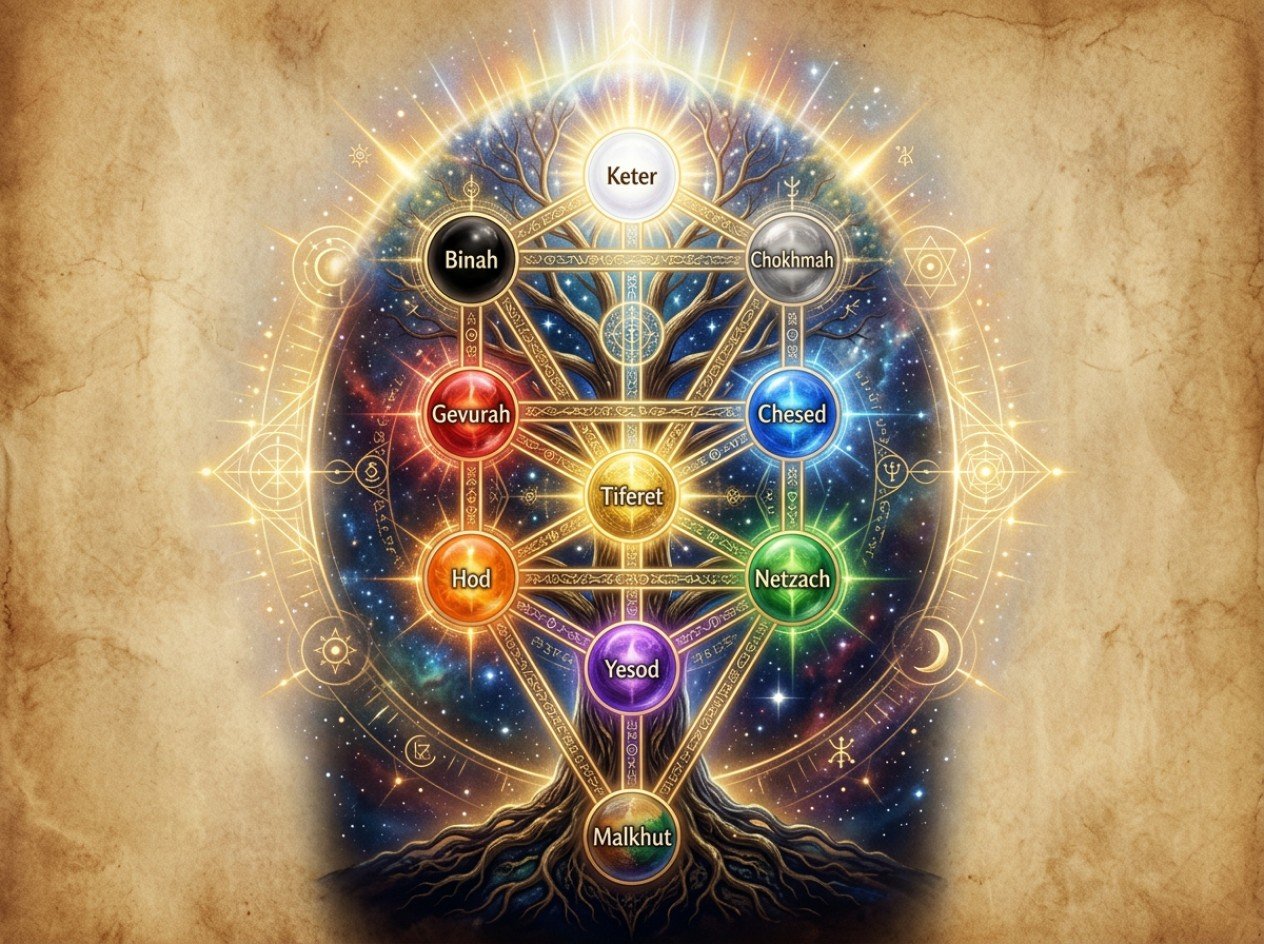
The Tree itself consists of ten Sefirot (סְפִירוֹת), often translated as "emanations," "attributes," or "divine expressions." I always hesitate slightly when translating that word because no single English term captures its full meaning. The Sefirot are not separate gods, nor are they independent spiritual beings. Judaism remains firmly committed to the belief in one indivisible God. Instead, the Sefirot symbolically represent different ways in which God's infinite nature is experienced within the finite world. They allow us to contemplate qualities that would otherwise remain beyond human understanding.
At the highest point of the Tree is Keter (כֶּתֶר), meaning "Crown." Keter represents the highest level of divine will and the source from which all the other Sefirot emerge. It symbolises potential before manifestation, purpose before action. Mystics often describe Keter as lying beyond ordinary human comprehension because it represents the closest point to God's unknowable essence. Rather than trying to define Keter precisely, Kabbalists encourage humility in recognising that some aspects of the Divine ultimately remain mysteries.
Beneath Keter appear Chokhmah (חָכְמָה), meaning "Wisdom," and Binah (בִּינָה), meaning "Understanding." These two Sefirot are often described as complementary partners. Chokhmah represents flashes of intuitive insight, those moments when an idea seems to appear almost fully formed. Binah, by contrast, develops, analyses, and gives structure to that inspiration. I sometimes compare them to creativity and careful editing. One generates possibility; the other shapes possibility into something meaningful. Together they remind us that wisdom requires both inspiration and thoughtful reflection.
Flowing downward we encounter Chesed (חֶסֶד), meaning "Loving-kindness" or "Mercy," and opposite it Gevurah (גְּבוּרָה), often translated as "Strength," "Judgement," or "Discipline." These two qualities illustrate one of the Tree's most important teachings: spiritual balance. Chesed reminds us to love generously, forgive readily, and care compassionately for others. Gevurah reminds us that kindness without wisdom can become permissiveness, and that healthy boundaries, justice, and accountability also express love. One of the reasons I find the Tree so psychologically insightful is that it continually emphasises balance rather than extremes.
The centre of the Tree lies
At the centre of the Tree lies Tiferet (תִּפְאֶרֶת), usually translated as "Beauty" or "Harmony." Tiferet brings together the opposing energies of mercy and judgement, compassion and discipline. Many Kabbalists view Tiferet as representing balance, integration, and spiritual maturity. Whenever I think about Tiferet, I'm reminded that genuine wisdom often consists not of choosing one extreme or another but of finding harmony between apparently opposing qualities. Compassion without wisdom may become ineffective, while justice without compassion may become harsh. Tiferet seeks their integration.
Lower on the Tree appear Netzach (נֵצַח), meaning "Endurance" or "Victory," and Hod (הוֹד), meaning "Splendour," "Humility," or "Acknowledgement." These two Sefirot reflect another important partnership. Netzach encourages perseverance, confidence, and the determination to continue moving forward despite obstacles. Hod reminds us of humility, gratitude, and the willingness to listen. Together they teach that genuine success requires both confidence and modesty. I often think modern society could benefit enormously from holding these two qualities in healthier balance.
The ninth Sefirah is Yesod (יְסוֹד), meaning "Foundation." Yesod gathers the energies of the upper Sefirot and channels them toward practical expression. Symbolically, it represents connection, relationships, communication, and integration. Just as the foundation of a building supports everything above it, Yesod reminds us that healthy spiritual lives require strong inner foundations. Our values, relationships, and daily choices become the means through which spiritual ideals enter ordinary life.
Finally, at the base of the Tree lies Malkhut (מַלְכוּת), meaning "Kingdom." Malkhut represents the physical world—the realm in which we live, work, love, struggle, and grow. What I appreciate most about this symbolism is that Kabbalah never suggests the physical world is somehow inferior to the spiritual one. On the contrary, Malkhut teaches that the material world becomes the place where spiritual principles find practical expression. Kindness, justice, generosity, honesty, and compassion only become meaningful when they are lived.
The Tree of Life & Repairing The World
One of the most influential ideas connected with the Tree of Life is Tikkun Olam (תִּיקּוּן עוֹלָם), usually translated as "repairing the world." Although the phrase appears in different ways throughout Jewish tradition, Kabbalah gave it particularly rich mystical significance. According to the teachings of Rabbi Isaac Luria, creation involved a cosmic process in which divine light became scattered throughout existence. Humanity's task is to help restore harmony by performing acts of kindness, justice, prayer, learning, and ethical living. Every compassionate action contributes, however modestly, to the healing of the world.
This is one reason I believe the Tree of Life remains so relevant today. It's easy to imagine spirituality as something detached from everyday concerns, but the Tree consistently points us back toward action. It asks not simply what we believe, but how we live. Are we cultivating compassion alongside wisdom? Are we balancing justice with mercy? Are we contributing something positive to our communities? These questions feel just as important walking through Manhattan today as they did centuries ago in medieval Spain.
The Tree of Life has also attracted interest beyond Judaism, particularly within Western esoteric traditions. While those systems have developed their own interpretations, I think it's important to remember that the Tree's origins remain firmly rooted in Jewish theology, Hebrew Scripture, and centuries of rabbinic scholarship. Appreciating its Jewish context enriches rather than limits our understanding. It reminds us that symbols grow from living traditions and carry the history, language, and faith of the communities that nurtured them.
What I find most beautiful about the Tree of Life is that it invites lifelong study without pretending to offer simple answers. Each return reveals something new because we ourselves continue changing. A quality that seemed abstract years ago suddenly becomes deeply personal after experiencing love, loss, parenthood, illness, or forgiveness. The Tree grows with us because it reflects the ongoing journey of becoming more fully human while seeking a closer relationship with the Divine.I don't think or believe that the Tree of Life exists to satisfy intellectual curiosity alone, although it certainly rewards careful study. Its deeper purpose is transformation. It reminds us that wisdom should lead to compassion, that knowledge should encourage humility, and that spirituality should become visible through kindness, justice, and generosity. Whether one approaches it as a student of Jewish mysticism, a person of faith, or simply someone searching for deeper meaning, the Tree of Life continues offering an extraordinary vision of a world held together not by power or certainty, but by balance, relationship, and the enduring possibility of healing.