


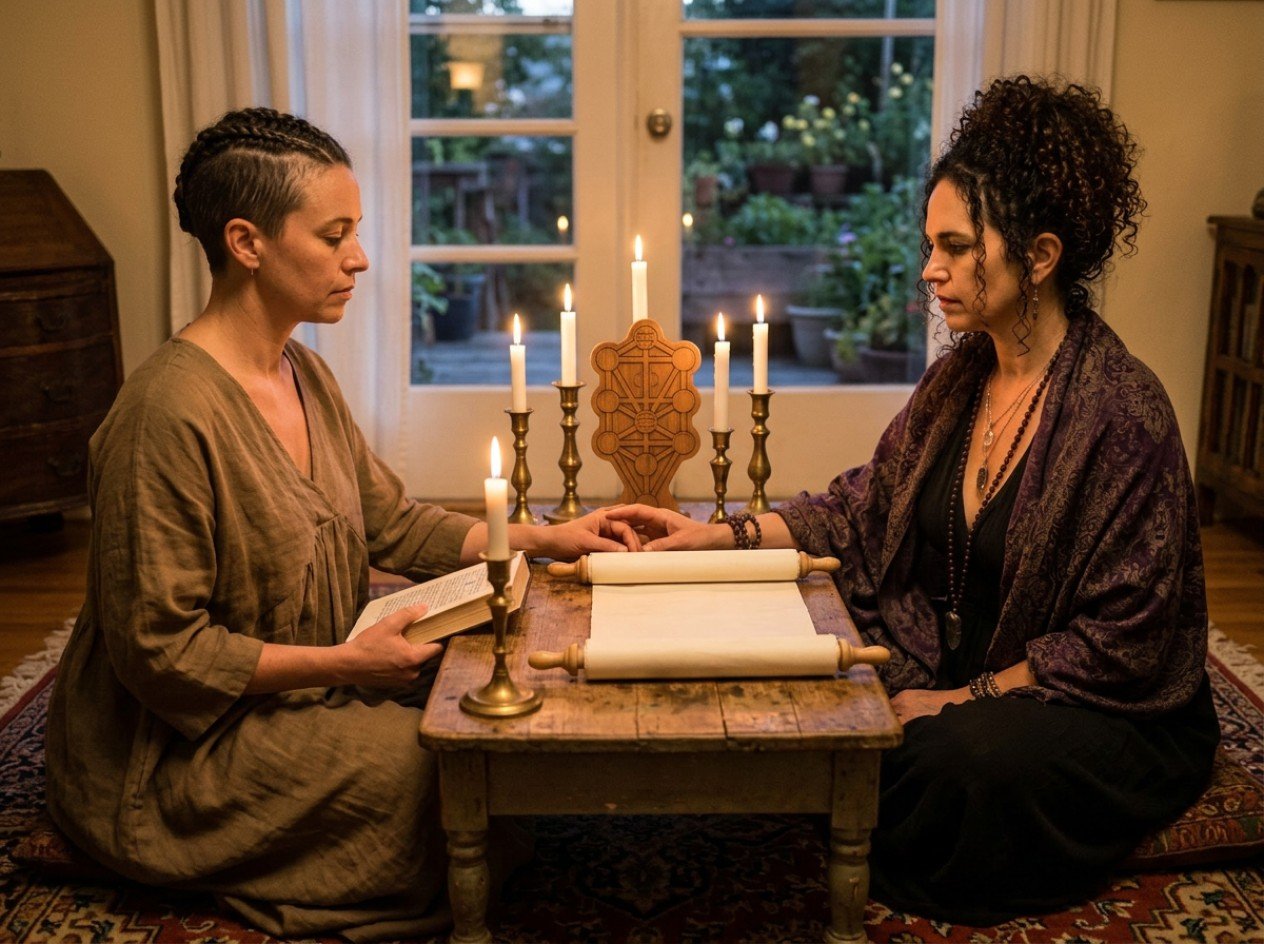
The Kabbalah, Jewish Mysticism & The Importance of Sex
My wife and I have a running joke that living in Greenwich Village means you can walk to a Kabbalistic study group, a drag show, and a five-hundred-year-old printing of the Zohar within the same afternoon, and none of these things are as far apart as they first appear. I mean that seriously, not just as a neighbourhood observation. The relationship between sexuality and the sacred in Jewish mysticism is one of the most theologically sophisticated, most philosophically daring, and most consistently misrepresented dimensions of the tradition I love. I want to spend some time today setting the record straight, or at least, setting it less crooked.
The Zohar
The starting point is the Zohar, the great masterwork of Kabbalistic literature, compiled in thirteenth-century Spain and attributed, almost certainly fictitiously but meaningfully, to the second-century sage Rabbi Shimon bar Yochai. The Zohar is not a comfortable text. It is dense, symbolic, frequently baffling, and saturated with an erotic theology that has made more than one reader do a double-take. The most fundamental structure of divine reality in the Zohar is relational and gendered: the Ein Sof, the infinite divine ground of being, expresses itself through the ten sefirot, the divine attributes, and the dynamic tension between these attributes is understood, consistently and explicitly, in terms of masculine and feminine principles in perpetual creative interaction. This is not metaphor in the decorative sense. The Zohar understands the sexual as one of the primary symbolic registers through which the nature of divine reality can be understood, because the sexual, the attraction of opposites, the creative union that produces new life, the vulnerability of genuine encounter, is one of the most available human experiences of what the divine is actually like.
The two sefirot that are most central to this erotic theology are Tiferet, the sixth attribute, associated with masculine divine energy, beauty, and the heart of the divine system, and the Shekhinah, also called Malkhut, the tenth sefirah, the feminine divine presence, the aspect of God that dwells in the world, that accompanies Israel in its exile, that is most directly accessible to human experience. The Shekhinah is one of the most significant theological developments in the entire Jewish mystical tradition: the explicit feminisation of the divine presence, the insistence that God has a feminine face and that this face is the one turned most directly toward creation. The Zohar's treatment of the Shekhinah is tender, erotic, and politically serious at the same time, the Shekhinah suffers in exile along with her people, she is separated from Tiferet by the sins and disorders of the world, and the work of religious life is partly the work of reuniting the feminine and masculine aspects of the divine in what the Kabbalists call the yichud, the sacred unification.
What this means in practice is one of the most remarkable theological moves in any religious tradition I know of i.e., human sexuality, performed consciously and with appropriate intention, becomes an act of cosmic significance. When a man and woman unite on the Sabbath, the Kabbalists were particular about the Sabbath, the night of rest and holiness, as the appropriate time, their union below mirrors and effects the union above. The hieros gamos, the sacred marriage between Tiferet and Shekhinah, is strengthened by the devout human couple's loving union. This is not a metaphor for something else. It is a genuine theological claim i.e., that embodied human sexuality, when approached with consciousness and holiness, participates in the repair of the divine reality itself. The body is not a cage the spirit must escape. It is the instrument through which the spirit most directly acts in the world.
The Kabbalah & Isaac Luria
The sixteenth-century Kabbalist Isaac Luria, working in Safed, in what is now northern Israel, producing what became the most influential development of Kabbalistic thought after the Zohar itself, took this already extraordinary theology and elaborated it into a complete system of cosmic repair. For Luria, the creation of the world involved a catastrophic shattering of the divine vessels, the shevirat ha-kelim, that scattered divine sparks throughout the material world. The human task, tikkun olam, the repair of the world, involves gathering these sparks and restoring them to their source. And within this system, the sacred sexual union retained its central importance: it was understood as a primary mechanism of tikkun, a way of reuniting what had been separated, of restoring the flow of divine energy through a creation that had been fractured at its origin.
The practical implications of this theology for how sexuality is understood within the Kabbalistic tradition are worth spelling out, because they run directly counter to the body-denying, pleasure-suspicious attitudes that are commonly but wrongly attributed to Jewish tradition as a whole. The Talmud already established the principle that a husband had an obligation, an actual legal obligation, to provide his wife with onah, sexual pleasure, as a regular duty of marriage. This was not a concession to human weakness. It was a recognition that sexual intimacy was intrinsically valuable, a component of human flourishing that deserved to be taken seriously and performed with care. The Kabbalistic tradition inherited and deepened this understanding: if human sexual union participates in divine union, then its quality matters. It should be characterised by mutual desire, genuine presence, love rather than merely legal compliance. The Iggeret HaKodesh, a medieval mystical text on sacred sexuality sometimes attributed to Nachmanides, is explicit on this point: the sexual act performed with holiness and with genuine love between partners is genuinely holy, not merely permitted, not merely tolerated, but holy in itself.
Jewish Mysticism
I teach a class at my synagogue on Jewish mysticism, and the session on sexuality is always the one that draws the most people and produces the most surprised faces. What surprises people most is not the explicitness, this is Greenwich Village, after all, but the seriousness. The Kabbalistic tradition is not treating sexuality as a guilty pleasure grudgingly permitted for the sake of procreation. It is treating it as a window into the nature of divine reality, as a practice that, when done with consciousness and love, participates in the healing of the world. That is a more radical and more beautiful theology of the body than almost anything else in the Western religious tradition.
There is a Zoharic passage I return to often, in which the divine masculine and feminine are described at their moment of union as a couple who have been separated and are finally restored to one another, the longing, the recognition, the joy of reunion. The Kabbalists understood this as a description of something happening within the divine reality itself. They also understood it as a description of something that every human couple, standing under the stars on a Friday night, was capable of participating in, if they brought to their union the quality of attention, love, and intentionality that the tradition asked of them. That image, the human love that mirrors and participates in the divine love, is, in my experience, one of the most genuinely moving things Jewish mysticism has to offer. The tradition at its most serious has never understood the body as the enemy of the soul. It has understood them as partners in the work of repair.