Ancient Egyptian Symbolism & Mysticism
One of the things I love most about studying ancient cultures is discovering how ideas that first appeared thousands of years ago continue to shape the way we think today. Living on the West Coast, where it's not unusual to find yoga studios next to art galleries, meditation centres across the street from museums, and bookstores filled with titles on mythology and spirituality, I'm constantly reminded that people are searching for meaning. Many of the symbols we encounter in modern spirituality have surprisingly ancient roots, and few civilizations have contributed more to the world's symbolic imagination than Ancient Egypt. Although separated from us by more than four thousand years, the Egyptians developed a symbolic language that continues to influence religion, art, architecture, psychology, literature, and modern mysticism.
To understand Egyptian symbolism, it's helpful to remember that the ancient Egyptians did not think of symbols as simply decorative images. Symbols were living expressions of deeper truths. They represented ideas about life, death, order, creation, the cosmos, and humanity's relationship with the divine. A symbol wasn't merely something that stood for another idea—it participated in that idea. This way of thinking may seem unfamiliar today, but it explains why Egyptian temples, tombs, jewellery, and everyday objects were filled with carefully chosen imagery designed to communicate spiritual meaning.
The civilisation we call Ancient Egypt flourished for over three thousand years, beginning around 3100 BCE. During that extraordinary span of history, political dynasties rose and fell, foreign rulers came and went, and religious beliefs evolved considerably. Yet many symbols remained remarkably consistent, suggesting that they expressed enduring cultural values rather than temporary fashions. Stability, balance, renewal, protection, wisdom, and harmony appear repeatedly throughout Egyptian art because these qualities formed the foundation of Egyptian society itself.
Egyptian Symbolism & Ankh
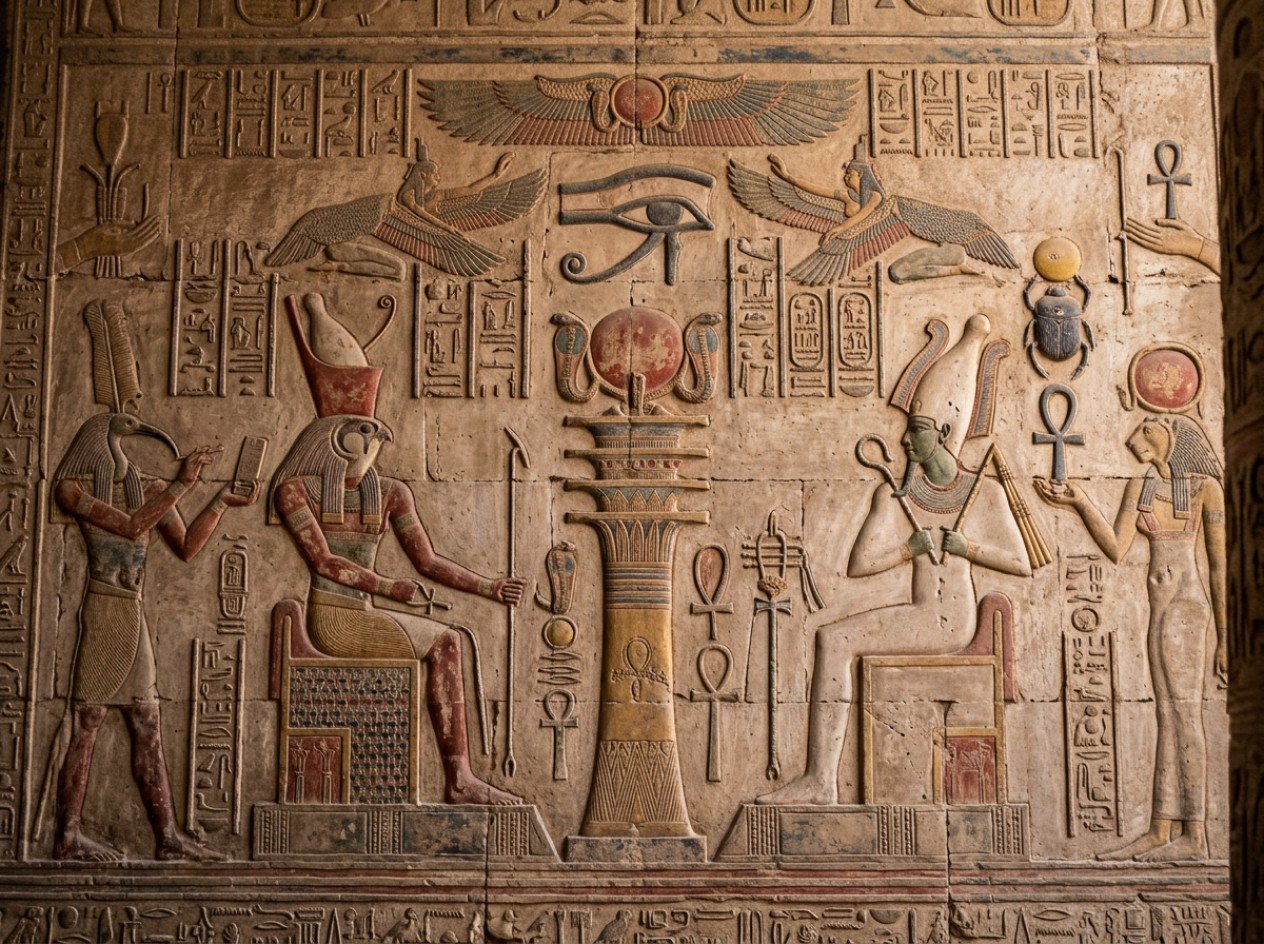
Perhaps the best-known Egyptian symbol is the Ankh, often called the "Key of Life" or the "Cross of Life." With its distinctive loop above a cross-shaped base, the Ankh appears in countless temple carvings, paintings, and statues. Egyptian gods are frequently depicted holding the Ankh or presenting it to kings as a gift. Traditionally, it symbolised life—not merely biological existence but life in its fullest spiritual sense. It represented vitality, divine blessing, and continuity beyond physical death. Today, the Ankh remains popular within modern spiritual communities because it has come to represent eternal life, personal growth, and the interconnectedness of the physical and spiritual worlds.
Another enduring symbol is the Eye of Horus, also known as the Wedjat Eye. According to Egyptian mythology, the god Horus lost his eye during a struggle with Seth before it was restored. As a result, the Eye became associated with healing, restoration, protection, and wholeness. Ancient Egyptians wore it as an amulet, painted it on coffins, and incorporated it into religious rituals. Even today, versions of the Eye appear in jewellery, tattoos, artwork, and spiritual literature as symbols of protection and inner awareness. Modern interpretations often describe it as representing intuition or the "third eye," although these ideas reflect later spiritual developments rather than original Egyptian theology.
The scarab beetle offers another fascinating example of symbolic continuity. Watching scarab beetles rolling balls of dung across the desert, the Egyptians associated them with the daily movement of the sun across the sky. The scarab became connected with the god Khepri, who represented the rising sun, creation, renewal, and transformation. To the Egyptians, the scarab symbolised rebirth because new life seemed mysteriously to emerge from the beetle's carefully constructed sphere. Today, scarabs continue appearing as symbols of personal transformation, resilience, and new beginnings. Their meaning has broadened, but the underlying theme of renewal remains remarkably consistent.
One of my favourite Egyptian concepts is Ma'at. Strictly speaking, Ma'at is both a goddess and a principle rather than simply a symbol. She represents truth, justice, harmony, balance, and cosmic order. Egyptian society believed that maintaining Ma'at was essential for the wellbeing of both the kingdom and the universe itself. Pharaohs were expected to uphold Ma'at through wise leadership, while ordinary people sought to live honestly and ethically. During the famous "Weighing of the Heart" ceremony described in the Book of the Dead, the deceased person's heart was weighed against the feather of Ma'at. If the heart remained balanced and unburdened by wrongdoing, the individual could continue into the afterlife.
Although few people today literally imagine their hearts being weighed after death, the symbolism remains surprisingly relevant. We still admire honesty, integrity, fairness, and balance. Modern discussions about living authentically, acting ethically, and finding inner equilibrium echo many of the values embodied by Ma'at thousands of years ago. Symbols endure because they express universal human aspirations.
Egyptian Symbolism & Animals
Animals also played an important symbolic role in Egyptian culture. Falcons represented kingship and divine vision through Horus. Cats became associated with Bastet, reflecting protection, motherhood, fertility, and domestic harmony. Jackals symbolised Anubis, guardian of embalming and guide of souls into the afterlife. I sometimes think people misunderstand these images, assuming Egyptians literally worshipped animals themselves. In reality, animals often served as symbolic expressions of divine qualities. Their natural characteristics helped communicate ideas that were otherwise difficult to express.
The lotus flower provides another beautiful example of symbolism that has travelled across cultures. Each morning the lotus emerges from muddy water and opens toward the sunlight before closing again at night. Egyptians naturally associated this daily cycle with creation, resurrection, purity, and spiritual awakening. Similar symbolism later appeared in Hinduism and Buddhism, where the lotus continues representing enlightenment emerging from the challenges of ordinary existence. It remains one of the world's most recognised spiritual symbols precisely because its message feels universally accessible.
Ancient Egyptian architecture itself functioned symbolically. Temples were not merely places of worship but representations of the ordered cosmos. Massive columns resembled papyrus plants or lotus flowers, while carefully aligned structures reflected celestial movements. The pyramids, perhaps the most famous monuments in history, continue inspiring endless speculation. Although modern popular culture often attributes supernatural mysteries to them, archaeologists understand them primarily as royal tombs expressing beliefs about kingship, resurrection, and eternal life. Their extraordinary precision nevertheless continues to evoke wonder and admiration.
It's fascinating to observe how Egyptian symbolism experienced a remarkable revival during the nineteenth and twentieth centuries. Following Napoleon's Egyptian campaign and later archaeological discoveries, particularly the opening of Tutankhamun's tomb in 1922, Egyptian motifs spread throughout Western art, architecture, jewellery, and fashion. The Art Deco movement embraced Egyptian geometry, while museums introduced millions of visitors to the civilisation's extraordinary artistic achievements. Symbols that had once belonged to temples along the Nile now appeared in theatres, hotels, books, and decorative design across Europe and North America.
Egyptian Symbolism & Modern Mysticisim
Modern mysticism has also incorporated many Egyptian symbols, although often with meanings that differ somewhat from their original historical context. The Ankh may represent universal spirituality rather than specifically Egyptian religion. The Eye of Horus is frequently associated with intuition, psychic awareness, or inner vision. Pyramid imagery often appears in discussions of personal transformation and higher consciousness. While these interpretations sometimes move beyond historical evidence, they demonstrate the remarkable adaptability of symbolic language. Symbols survive because each generation discovers fresh relevance within them.
Psychology offers another interesting perspective. Carl Jung argued that many symbols recur across cultures because they express universal patterns within the human psyche. Whether or not one fully accepts Jung's theory of archetypes, it helps explain why Egyptian imagery continues resonating with modern audiences. Life, death, transformation, protection, wisdom, balance, and renewal remain fundamental aspects of human experience. The symbols endure because the questions they address have never disappeared.
At the same time, it's important to approach Egyptian symbolism respectfully and historically. Popular culture occasionally presents Ancient Egypt as possessing secret mystical knowledge unavailable elsewhere. While Egyptian civilisation undoubtedly developed sophisticated religious and philosophical ideas, those ideas emerged within a specific historical, cultural, and linguistic context. Appreciating that context allows us to understand the symbols more accurately while still recognising their broader influence upon later traditions.
One lesson I find especially meaningful is that Egyptian symbolism rarely separated the spiritual from the practical. Maintaining balance, acting ethically, respecting nature, honouring community, and preparing thoughtfully for the future were all considered spiritual responsibilities. In many ways, this feels refreshingly modern. We continue searching for lives that integrate purpose, compassion, responsibility, and personal growth rather than dividing them into separate compartments.
The enduring appeal of Ancient Egyptian symbolism lies in its extraordinary ability to speak across time. Although we no longer build pyramids or worship the gods of the Nile, we still seek healing, wisdom, justice, hope, renewal, and meaning. We continue asking many of the same questions the Egyptians asked thousands of years ago: How should we live? What gives life purpose? How do we create harmony within ourselves and our communities? Symbols such as the Ankh, the Eye of Horus, the scarab, the lotus, and the feather of Ma'at continue inspiring us because they remind us that humanity's deepest concerns have changed far less than our technologies. Their lasting legacy is not simply artistic beauty, but their invitation to reflect upon the timeless values that continue connecting us across civilizations and across the centuries.