


Buddhist Meditation
When people first hear the word "meditation," they often imagine someone sitting cross-legged on a mountaintop with a perfectly quiet mind. It's a lovely image, but the reality is both simpler and far more interesting. Meditation, especially within Buddhism, isn't about escaping the world or eliminating every thought that enters your mind. Instead, it's a practical and compassionate way of learning how to understand your own mind more clearly. Living here on the West Coast, where mindfulness has become part of everyday conversation, I've met people from every imaginable background who have discovered that Buddhist meditation offers something remarkably valuable—not because it promises perfection, but because it helps us become more present, more compassionate, and more at peace with ourselves.
Buddhist meditation has a history stretching back more than 2,500 years to the teachings of Siddhartha Gautama, who became known as the Buddha, meaning "The Awakened One." After years of searching for answers about suffering and happiness, the Buddha concluded that lasting peace could not be found through wealth, status, or even extreme self-denial. Instead, it arose through understanding the nature of the mind itself. Meditation became one of the central practices through which individuals could cultivate wisdom, compassion, and freedom from unnecessary suffering.
One of the beautiful things about Buddhism is that it approaches meditation less as a mystical technique and more as a practical form of mental training. Just as physical exercise strengthens the body, meditation strengthens qualities such as concentration, emotional balance, kindness, and self-awareness. It doesn't ask us to believe blindly in particular ideas. Rather, it encourages personal experience. The Buddha himself often encouraged his followers to explore his teachings thoughtfully rather than accepting them without question.
The Heart of Buddhist Meditation
At the heart of Buddhist meditation lies the recognition that our minds are constantly active. Thoughts arise, emotions come and go, memories appear unexpectedly, and worries about the future compete with reflections on the past. Most of the time, we follow these thoughts automatically without even realising it. Meditation gently interrupts that pattern. Instead of becoming carried away by every passing thought, we learn to observe our experience with curiosity and patience.
One of the foundational forms of Buddhist meditation is known as Samatha, a Pali word meaning "calm" or "tranquillity." The goal of Samatha meditation is to develop steady concentration. Practitioners often focus upon the natural rhythm of the breath, allowing attention to settle gently on each inhalation and exhalation. Whenever the mind wanders, which it naturally does, they simply notice the distraction and kindly return their attention to the breath. There is no need for frustration or self-criticism. Each return strengthens the ability to remain present.
Closely connected with Samatha is another important practice called Vipassana, meaning "insight" or "clear seeing." While Samatha develops stability, Vipassana encourages understanding. During insight meditation, practitioners observe thoughts, sensations, emotions, and experiences as they arise and pass away. Rather than judging these experiences as good or bad, they simply notice their changing nature. Over time, this practice reveals one of Buddhism's central teachings: everything is constantly changing. Thoughts come and go. Emotions rise and fall. Even difficult experiences eventually pass. Recognising this impermanence often reduces unnecessary attachment and anxiety.
Buddhist Meditation & Mindfulness
Mindfulness, now widely practiced around the world, has its roots in these Buddhist traditions. The Pali word Sati is usually translated as "mindfulness," but it carries a richer meaning than simple awareness. It refers to remembering to remain fully present in whatever we are doing. Whether eating breakfast, washing dishes, walking through a park, or listening to a friend, mindfulness invites us to participate completely in the present moment rather than living entirely inside our thoughts.
Another deeply moving practice is Metta, commonly translated as "loving-kindness." Metta meditation encourages us to cultivate genuine goodwill toward ourselves and others. Practitioners silently repeat phrases such as, "May I be happy. May I be healthy. May I be peaceful." Gradually these wishes extend outward to loved ones, acquaintances, strangers, and even people with whom we have experienced conflict. What I particularly love about Metta meditation is that it reminds us compassion is not simply an emotion we wait to feel. It is a quality we can intentionally nurture through regular practice.
Closely related is Karuna, the cultivation of compassion. While loving-kindness focuses upon wishing wellbeing, compassion involves recognising suffering and responding with kindness. Buddhist meditation encourages us to become more aware of both our own struggles and those experienced by others. Rather than becoming overwhelmed by suffering, compassion meditation develops emotional resilience, allowing us to respond thoughtfully instead of turning away.
One misconception I often hear is that meditation means trying to stop thinking altogether. In reality, thoughts continue arising because that's simply what healthy minds do. Meditation changes our relationship with those thoughts. Instead of becoming entangled in every worry or memory, we begin recognising thoughts as passing mental events rather than permanent truths. This simple shift often creates remarkable emotional freedom.
Breathing naturally occupies a central place in many Buddhist meditation practices because it is always available. The breath anchors attention in the present moment. Whenever the mind wanders into future worries or past regrets, gently returning to the breath reminds us that peace is found here, in this moment, rather than somewhere else. No special equipment or perfect conditions are required. Every breath offers another opportunity to begin again.
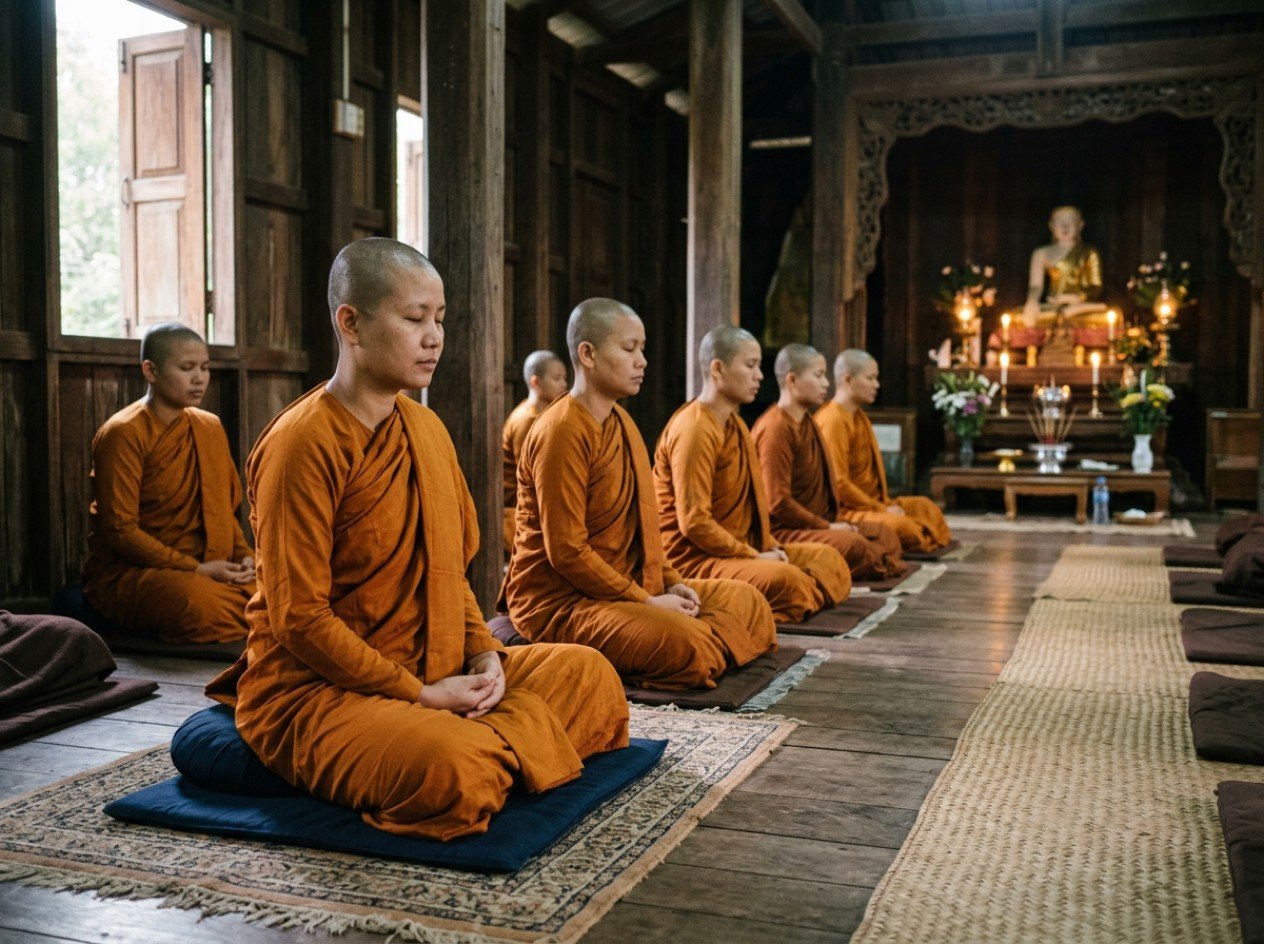
Buddhist meditation also emphasises the importance of posture, although perhaps not as rigidly as people sometimes imagine. Sitting comfortably with an upright yet relaxed spine encourages both alertness and ease. Some people meditate on cushions, others use chairs, and some practice while walking slowly. Walking meditation itself becomes a beautiful exercise in mindfulness, with attention placed upon each step, each movement, and each sensation of contact with the ground.
Buddhism & The Gradual Reduction of Suffering
One of Buddhism's most profound goals is the gradual reduction of suffering. The tradition teaches that much of our distress arises not simply from painful experiences themselves but from the way we cling to pleasant experiences or resist unpleasant ones. Meditation helps us recognise these habitual patterns. As awareness deepens, we gradually respond with greater flexibility rather than automatic reaction. This doesn't eliminate life's difficulties, but it changes how we meet them.
Patience plays an enormous role in Buddhist practice. Modern culture often encourages quick results, yet meditation develops gradually, much like learning a musical instrument or cultivating a garden. Some sessions feel wonderfully peaceful, while others seem filled with distractions. Both experiences are perfectly normal. The value lies not in achieving an ideal state but in returning consistently to the practice with kindness and curiosity.
Ethics also occupy a central position within Buddhism. Meditation is not viewed as separate from daily life but as part of a broader path that includes honesty, generosity, compassion, and mindful speech. As meditation deepens, many practitioners naturally become more patient, less reactive, and more aware of how their actions affect others. Inner transformation gradually expresses itself outwardly through behaviour.
It's interesting that modern neuroscience has begun exploring many of meditation's psychological effects. Research suggests regular mindfulness practice may improve attention, emotional regulation, stress-management, and overall wellbeing. While Buddhism developed these practices long before modern science existed, many people today appreciate seeing how ancient contemplative traditions and contemporary research sometimes arrive at complementary conclusions.
One of the aspects I appreciate most about Buddhist meditation is its accessibility. You don't need expensive equipment, perfect silence, or hours of free time. Five or ten minutes practiced consistently can begin creating meaningful changes. Over time, mindfulness gradually extends beyond formal meditation sessions into everyday life. Conversations become more attentive. Meals become more enjoyable. Difficult emotions become easier to navigate. Even waiting in traffic becomes an opportunity to practice patience rather than frustration.
Buddhist meditation isn't about becoming a different person. But rather it is about gradually uncovering qualities that already exist within us: wisdom, compassion, patience, generosity, and inner stability. Through practices such as Samatha, Vipassana, mindfulness, loving-kindness, and compassion meditation, we learn to relate to ourselves and the world with greater clarity and kindness. Whether someone approaches these practices from a Buddhist perspective or simply as tools for personal wellbeing, their enduring value lies in one gentle invitation: to slow down, pay attention, and meet each moment with an open heart. In our fast-moving world, that may be one of the most meaningful gifts meditation has to offer.