


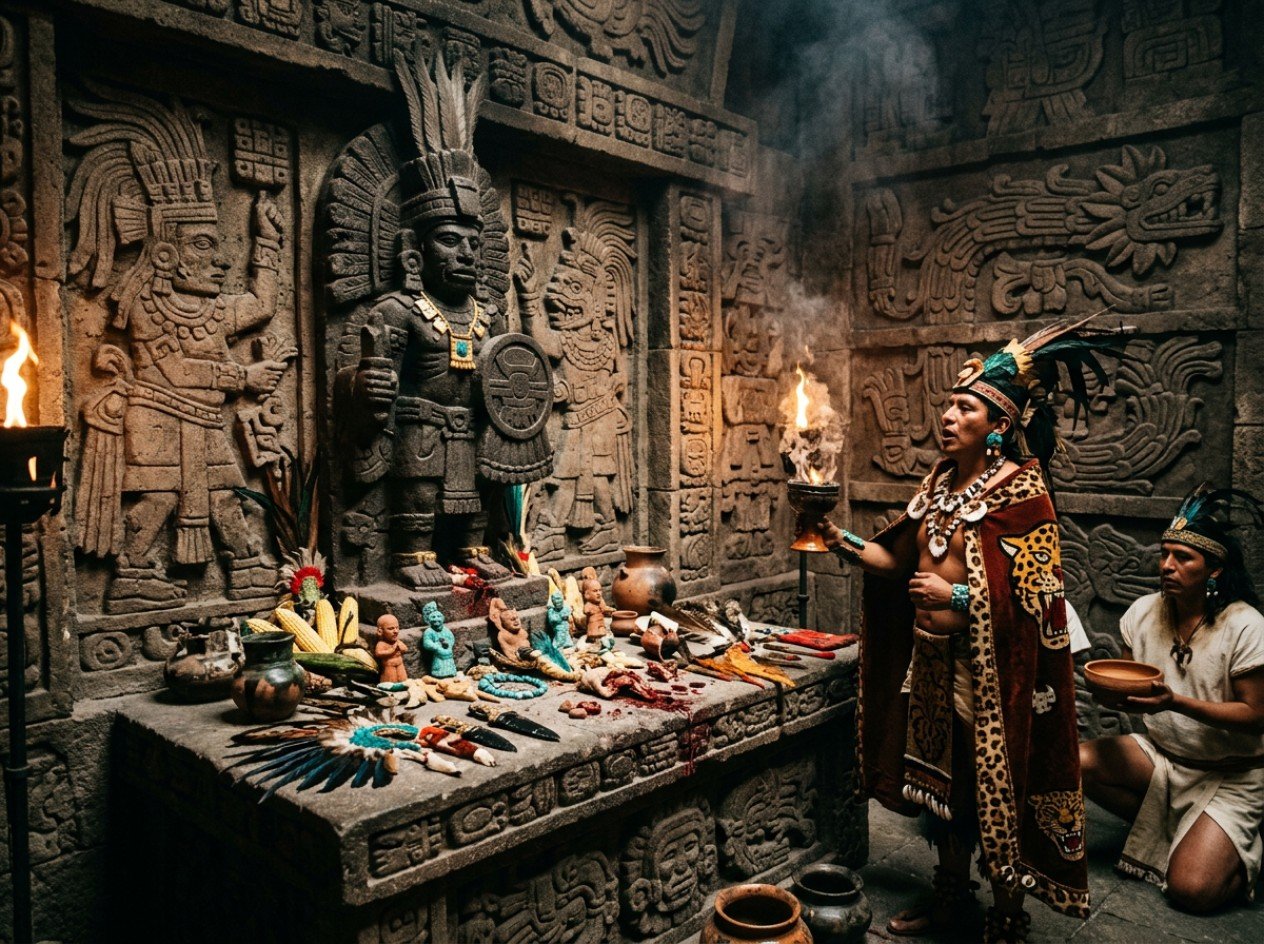
Aztec Beliefs & Gods
Among the great civilizations of the ancient Americas, few have captured the imagination quite like the Aztecs. Their magnificent capital city, sophisticated political organization, monumental architecture, vibrant artistic traditions, and richly symbolic religious beliefs continue to fascinate historians, archaeologists, and students of comparative religion. Yet popular portrayals often reduce Aztec civilization to little more than human sacrifice, overlooking the remarkable complexity of their worldview. As with any ancient culture, understanding the Aztecs requires appreciating the broader religious and philosophical system within which their practices developed. Their gods, myths, rituals, and cosmology were not isolated beliefs but interconnected elements of an elaborate vision of the universe and humanity's place within it.
The civilization we refer to as the Aztecs called themselves the Mexica (pronounced Meh-shee-ka). During the fourteenth century, they established their capital city, Tenochtitlan, on an island in Lake Texcoco, where modern-day Mexico City now stands. By the early sixteenth century, Tenochtitlan had become one of the largest and most impressive cities in the world, with an estimated population exceeding 200,000 inhabitants. Wide canals, causeways, bustling markets, temples, schools, and carefully planned neighborhoods reflected a highly organized society whose political strength was matched by remarkable cultural sophistication.
Religion & Aztec Life
Religion occupied the very centre of Aztec life. Unlike modern societies, where religion may be regarded as one aspect of culture among many, the Aztecs understood nearly every activity through a sacred lens. Agriculture, warfare, government, trade, education, and family life all reflected their relationship with the gods. The universe itself was viewed as a living, dynamic system sustained through reciprocal relationships between humanity and the divine powers that governed creation.
Central to Aztec cosmology was the belief that the universe had passed through several previous ages, each known as a "Sun." According to their creation myths, four earlier worlds had been created and destroyed through various catastrophes, including floods, fierce winds, jaguars, and fire. Humanity now lived during the era of the Fifth Sun, which itself would eventually come to an end. This belief gave their religion a profound sense of cosmic urgency. Maintaining harmony between humanity and the gods became essential because the continued existence of the world depended upon it.
One of the most important deities within the Aztec pantheon was Huitzilopochtli, the god of the Sun, warfare, and the patron deity of the Mexica people. According to tradition, Huitzilopochtli guided the Mexica during their long migration before instructing them to establish Tenochtitlan at the location where they observed an eagle perched upon a cactus while holding a serpent in its beak. This image remains one of Mexico's national symbols today and appears prominently on the country's flag.
Huitzilopochtli represented not simply military conquest but the daily triumph of light over darkness. Every sunrise symbolized his victory against the forces threatening cosmic order. Because the Aztecs believed the Sun required nourishment to continue its journey across the sky, rituals honouring Huitzilopochtli occupied an especially important place within religious life. While these beliefs later became associated with practices that modern audiences understandably find disturbing, they reflected a broader theological conviction that humanity participated directly in sustaining the balance of the universe.
Quetzalcoatl & Tezcatlipoca
Another central deity was Quetzalcoatl, whose name means "Feathered Serpent." Quetzalcoatl remains one of the most fascinating figures in Mesoamerican religion because he embodied numerous complementary qualities. Associated with wisdom, learning, wind, creation, fertility, and priesthood, Quetzalcoatl represented civilization itself. Many traditions credited him with giving humanity knowledge, agriculture, writing, astronomy, and the calendar. Unlike some warrior deities, Quetzalcoatl often symbolized intellectual and spiritual refinement, making him one of the most widely revered gods throughout Mesoamerica long before the rise of the Aztec Empire.
Closely associated with Quetzalcoatl was Tezcatlipoca, whose name may be translated as "Smoking Mirror." Tezcatlipoca governed destiny, change, conflict, rulership, and the mysterious forces shaping human existence. If Quetzalcoatl represented order and wisdom, Tezcatlipoca often represented unpredictability, transformation, and the difficult lessons accompanying power. The relationship between these two gods illustrates an important feature of Aztec religion: balance frequently emerged through opposing yet complementary forces rather than simple divisions between good and evil.
The rain god Tlaloc held enormous importance within an agricultural society dependent upon successful harvests. Tlaloc governed rain, rivers, springs, mountains, fertility, and agricultural abundance. Farmers prayed for his favour because timely rainfall determined whether crops would flourish or fail. His imagery frequently includes distinctive goggle-like eyes and fanged features, making him one of the most recognisable deities within Aztec art. Alongside Tlaloc stood Chalchiuhtlicue, goddess of lakes, rivers, streams, and fresh water, representing the nurturing qualities associated with life-giving water.
Aztec Female Dieties
Among the female deities, Coatlicue, meaning "She of the Serpent Skirt," occupied a particularly significant role. As the mother of Huitzilopochtli and many other gods, she represented both creation and destruction, fertility and mortality. Her famous stone statue, now housed in the National Museum of Anthropology in Mexico City, remains one of the greatest masterpieces of pre-Columbian sculpture. Although initially intimidating to modern viewers, the statue expresses profound theological ideas concerning the interconnected cycles of birth, death, and renewal.
The Aztec understanding of death differed considerably from many modern religious traditions. Rather than determining one's afterlife primarily through moral behaviour, the destination of the soul often depended upon the manner of death. Warriors who died in battle and women who died during childbirth—both viewed as making significant sacrifices for society—were believed to accompany the Sun during part of its daily journey. Those who drowned entered the paradise of Tlaloc, while many others travelled to Mictlan, the underworld ruled by Mictlantecuhtli and his consort Mictecacihuatl. Reaching Mictlan required a difficult four-year journey through numerous symbolic challenges before the soul finally found rest.
The Aztecs possessed an extraordinarily sophisticated understanding of time. Their calendar system combined a 260-day ritual calendar known as the Tonalpohualli with a 365-day solar calendar called the Xiuhpohualli. Together these calendars created a fifty-two-year cycle of immense religious significance. At the conclusion of each cycle, the Aztecs performed the famous New Fire Ceremony, extinguishing every fire throughout the empire before ceremonially rekindling a sacred flame atop a mountain. This ritual symbolized the renewal of both time and the universe itself.
Education also reflected religious values. Young people attended schools where they learned not only practical skills but also moral responsibilities, religious traditions, poetry, music, history, and military training. Priests occupied respected positions within society because they preserved sacred knowledge, maintained temple rituals, interpreted calendars, and conducted ceremonies. Far from functioning solely as religious specialists, they also served as scholars, astronomers, teachers, and advisors.
Aztec Human Sacrifice
One aspect of Aztec religion that understandably receives considerable attention is human sacrifice. Modern readers often find this practice deeply troubling, and it is important neither to minimise nor sensationalise it. Human sacrifice certainly occurred and formed part of some important religious ceremonies. However, reducing Aztec civilization entirely to this practice obscures the richness of their philosophical, artistic, and intellectual achievements. Within their own worldview, sacrifice reflected beliefs concerning cosmic reciprocity rather than cruelty for its own sake. The gods had sacrificed themselves to create the present world, and humanity, in turn, bore responsibilities toward maintaining cosmic order. Understanding this theological context does not require approving of the practice; rather, it allows us to appreciate how profoundly different cultural worldviews may shape ethical and religious beliefs.
Aztec art and architecture reflected these religious convictions beautifully. The towering Templo Mayor in Tenochtitlan served as the empire's principal ceremonial centre, dedicated jointly to Huitzilopochtli and Tlaloc. Sculptures, murals, featherwork, ceramics, and codices displayed intricate symbolic imagery communicating theological concepts through visual language. Colour itself carried symbolic meaning, while animals such as eagles, jaguars, serpents, hummingbirds, and butterflies represented particular divine qualities or spiritual transformations.
Astronomy occupied another central place within Aztec religion. Careful observations of the Sun, Moon, Venus, and seasonal cycles guided agricultural planning, ceremonial calendars, and religious festivals. Like many ancient civilizations, the Aztecs viewed celestial movements not simply as physical phenomena but as meaningful expressions of divine order. Their observations demonstrated impressive precision achieved through centuries of systematic study.
The arrival of the Spanish under Hernán Cortés in 1519 transformed Aztec civilization irrevocably. Within only a few years, disease, warfare, political alliances, and conquest led to the collapse of the Aztec Empire. Many temples were destroyed, religious practices suppressed, and countless codices burned. Nevertheless, important aspects of Aztec culture survived through oral traditions, surviving manuscripts, archaeology, language, and the enduring heritage of Indigenous communities throughout Mexico.
Today, historians continue reconstructing Aztec religion through archaeological discoveries, colonial-era documents, surviving codices, and comparative studies of other Mesoamerican cultures. Increasingly, scholars recognise the importance of understanding Aztec beliefs on their own terms rather than viewing them solely through European accounts written during the colonial period. This balanced approach reveals a civilization of remarkable intellectual sophistication whose religious imagination sought to explain humanity's relationship with nature, time, death, creation, and the cosmos. The study of ancient Aztec beliefs reminds us that religion has always reflected humanity's deepest attempts to understand existence. Although separated from us by centuries and shaped by cultural assumptions very different from our own, the Aztecs wrestled with familiar questions. How did the world begin? What sustains life? What happens after death? What responsibilities do human beings owe to one another and to the sacred? Their answers differed profoundly from those offered by many later traditions, yet their search for meaning remains recognisably human. By studying their gods, myths, rituals, and cosmology with both historical accuracy and cultural respect, we gain not only a deeper appreciation of one of history's greatest civilizations but also a richer understanding of humanity's enduring spiritual imagination.